Not your Father’s Summer Vacation
 While some of us kicked back and relaxed this past summer, 69 students and 41 faculty members spent their “vacations” collaborating on scholarly and creative projects in fields related to the arts and humanities, the social and physical sciences, business, and engineering as part of the College’s Mentored Undergraduate Summer Experience.

While some of us kicked back and relaxed this past summer, 69 students and 41 faculty members spent their “vacations” collaborating on scholarly and creative projects in fields related to the arts and humanities, the social and physical sciences, business, and engineering.
The College’s Mentored Undergraduate Summer Experience (MUSE) brought together participants from 21 different academic departments for an intensive, eight-week program, said Janet Morrison, associate professor of biology and director of faculty-student collaborative activity at TCNJ.
Admission to MUSE was competitive. To be considered, faculty members submitted a proposal outlining the students with whom they wanted to work, the scope of their project, the benefits to the students involved, and any past experience collaborating with students. A selection committee made up of representatives from each school as well as the academic affairs office evaluated the projects and decided which ones to fund.
For the students involved, MUSE offered a powerful learning experience. “They got to see what it is like to be the kind of scholars that their professors are,” Morrison said.
The students were involved in every aspect of their individual project, from the planning stages through the actual creative or scholarly work. Many of them will continue their work in the coming year and present it at next spring’s Celebration of Student Achievement, explained Morrison. Some could attend professional conferences with their mentor to present their work, she added.
Each student received a stipend and the offer of on-campus housing during the eight-week program. In addition to the day-to-day scholarly or creative work with their mentors, the students regularly met as a full group for discussions, workshops, forums, and professional development programming. Topics addressed included “Ethics in Research” and “Finding Sources of Grant Money.”
“Students were a part of a scholarly community, hearing all the time about other projects that were going on and learning about other disciplines and ideas,” said Morrison. “It was a fabulous opportunity for them.”
Josette Marrero ’09 agreed. “What better way to use two months than working with your professor on a project that you feel really close to,” she asked.
Marrero, Shawn Donnelly ’09, and Kevin Fowler ’09 collaborated with John Allison, professor and director of forensic chemistry, on a questioned-document analysis project. The group investigated documents created using an inkjet printer, which many counterfeiters use to produce fake currency or false identification documents. “Our interest was in the analysis of compounds that create color and the use of such an analysis in the field of forensics,” Allison said.
“The project was suggested by chemists at the Secret Service who expressed a need for new methods to analyze inks from new inkjet printers, which use pigments instead of dyes as colorants,” Allison said. “Our goal is to develop new methods for forensic scientists.” The work will continue in the new academic year.
Assistant Professor of Biology Keith Pecor and Sarah Wolfson ’10 collaborated on a study of the distribution and ecology of several species of native and exotic crayfish in New Jersey. “The project grew out of a sort of dual need on my part,” said Pecor.
He explained that the last formal research on the distribution of crayfish in New Jersey had been done in the 1950s. “In order to do the lab work we do, we needed to know where we could find the animals with which to do that work. So we went out and spent part of the summer looking for [crayfish] to see if those distributions were still accurate,” Pecor said.
Then, he and Wolfson moved into the lab to study the chemical ecology of New Jersey’s native and exotic crayfish. Their work will also continue into the fall semester.
Both were grateful for the funding they received, which enabled their participation in MUSE. “I wouldn’t necessarily be able to have a student like Sarah and be able to engage in a project like this over the course of the summer if it wasn’t for such a program,” Pecor said.
Funding for MUSE came from a variety of sources. Many of the projects were funded internally, which Morrison said is a sign of the College’s strong commitment to the faculty-student collaborative experience.
“You’ll see programs similar to MUSE at other undergraduate institutions, but the fact that TCNJ has committed the level of internal funding to the program that it has is quite unusual,” Morrison explained. She credited Beth Paul, vice provost, with championing MUSE and ensuring that it was a priority budget item.
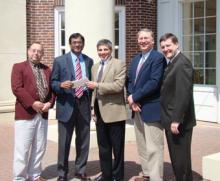
Morrison was quick to add that there would not have been as many opportunities for faculty/student collaboration without the help of several generous donations. For instance, The National Starch and Chemical Foundation (NSC/ICI) sponsored five chemistry projects. Merck/AAAS sponsored two projects in the bio-chem fields. A grant from the National Science Foundation funded an interdisciplinary multimedia/computer science/ journalism project. And the National Conferences on Undergraduate Research and the Alice and Leslie E. Lancy Foundation continued funding of a multipart research study examining community and environmental transitions in Trenton.
One part of the Trenton project was a collaboration between Sarah Cunninghan, director of the College Art Gallery, and Michelle Nugent ’09. Nugent completed a mosaic at Homan Park in Trenton, volunteered at Artworks’ Art All Night, designed a logo for Farmers Against Hunger, and worked with children attending camps in the Trenton community to paint a large-scale mural in the gymnasium of the West Ward Center, which provides a free after-school program to Trenton residents.
“I have been looking for opportunities to build meaningful ties between the College Art Gallery and the community, especially in regards to programs for at-risk youth. Doing a community-based arts education program was a tangible way to begin this relationship,” said Cunningham.
Benny Chan, assistant professor of chemistry, and Sergio Pulido ’09 also took part in MUSE. The two first collaborated in 2007 on a study of the properties of frustrated materials. These materials have magnetic centers that, due to their structures, do not align in the way that is predicted. Knowledge of the materials’ properties could lead to a better understanding of superconducting materials and, ultimately, could have applications in medical MRI equipment, magnetic levitation, and zero-loss electricity lines. A National Science Foundation award Pulido received funded the work last year. The two were able to continue the work this year because of funding received from NSC/ICI.
Sarah Wehrhan ’11 joined their team this summer because of her interest in energy-related research. Together, the three researchers began a fundamental study of how to synthesize solid-state chalcogenide materials, which can potentially be applied to thermoelectrics. They also began experiments to make nitride nanostructures for use in nanotechnology. Their hope is to continue these projects into the fall semester.
“I think MUSE is a very strong educational component for their chemistry program,” Chan said of his students. “The students learn more doing research than they can in a classroom. It’s much more hands-on type learning and learn-as-you-go.”
In the area of social sciences, communication studies Professor John Pollock collaborated with Paul D’Angelo, assistant professor of communication studies; Donna Shaw, assistant professor of journalism; and communication studies students Janna Raudenbush ’09, Kristen Kiernicki ’09, and Amanda Burd ’09 on a project examining newspaper coverage of AIDS in 13 sub-Saharan English-speaking countries in Africa.
The team examined over 2,000 African newspaper articles, assessing various factors such as how much emphasis was placed on government responsibility versus society’s responsibility for taking action against AIDS. The team also looked at how AIDS was portrayed and whether it was framed as something that is progressing, declining, or remaining neutral in activity.
The work is continuing into this academic year, Pollock said. The team plans to interview journalists in Africa to learn how they think about their roles as journalists and whether they consider themselves neutral or as advocates of a particular perspective. Pollock will be on leave during the fall semester to work on the project full time.
The group will be submitting its work in November to the prestigious International Communications Association. Eventually, Pollock and D’Angelo would like to produce a book of their findings.
“There is an enormous silence regarding HIV and AIDS in Africa,” Pollock said. “We can be part of an effort to retrain journalists in Africa to be more proactive in reporting on AIDS.”
Taking part in MUSE wasn’t all work for the students though. During the eight-week program, they were given the chance to unwind by participating in community-building activities such as canoeing, bowling, and laser tag.
“We wanted them to have some fun as well,” Morrison said. “It was the summer after all.”
Watch videos on a handful of MUSE projects
Posted on August 14, 2008