
Mitchell Speeds to Final Leg of ACL Injury
Field hockey and lacrosse standout Leigh Mitchell ’11 was on her way to a storybook career until she tore her ACL during a routine practice drill. Read how one Lion has worked to battle back from this all-too-common sports injury.
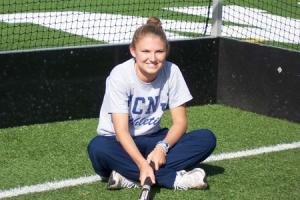
Things have always come easily to Leigh Mitchell ’11 at Lions’ Stadium. Whether she’s toting a lacrosse or field hockey stick at The College of New Jersey, when Mitchell toes the turf her presence is synonymous with exceptional quickness and the ability to score. She has what coaches describe as “a nose for the goal.”
Through her freshman and part of her sophomore seasons, Mitchell was busy penning chapters to a storybook career at TCNJ. She was the 2007 NJAC Rookie of the Year in field hockey, racking up 16 goals and four assists, and followed that up by being named to the NFHCA Division III All-America First Team with 19 goals in her sophomore campaign. During the spring of 2008, Mitchell took her scoring act to lacrosse and tallied 25 goals in her inaugural season.
If there was a mountain range overlooking campus, Mitchell stood at its pinnacle point. Through the first six games of the 2009 lacrosse season, Mitchell was unstoppable, scoring 22 goals while dishing out 10 assists. But during a routine practice drill at her favorite venue, she attempted a quick change of direction—a move she’d performed thousands of times as a field hockey, lacrosse, and high school basketball player. This time, however, it was a shift that altered the course of her career in an instant. Mitchell tore her Anterior Cruciate Ligament (ACL) and suffered a slight tear in her meniscus. Her lacrosse and forthcoming field hockey season were over.
“We were in practice going over plays,” recalled Mitchell. “I ran one way, went to pivot and turn, and my foot just stayed while my whole body turned. As soon as it happened I knew it was something bad that happened. I thought to myself, ‘There goes my season.’”
The injury Mitchell sustained is one that is all-too-common in the world of sports. The acronym, ACL, is universal jargon amongst high school and college athletes due to the frequency of the injury. It is one of four main ligaments that is located inside the knee and runs from the thigh bone (femur) to the shin bone (tibia). Its function is to keep the tibia from sliding forward and stabilizes the knee when it twists. Sports that involve cutting (or changing direction) such as soccer, lacrosse, football, or field hockey place greater stress on the role of this ligament and most ACL injuries are non-contact related.
This is precisely what happened to Mitchell. And while she was experiencing physical pain down on the turf at Lions’ Stadium, it was the emotional heartache she felt in connection with the teammate holding her hand that would be the initial hurdle to overcome. Her sister, Kelly Mitchell ’08, was a senior defender, and after the two had garnered All-American honors during the fall field hockey season, it meant their days of playing together for TCNJ had suddenly come to an unceremonious conclusion.
“My heart dropped to the turf,” explained Head Coach Sharon Pfluger ’82. “I knew she was hurt because she never stays down when she falls. Her sister Kelly had such concern on her face as she held Leigh’s hand. The three of us just sat on the turf as we waited to take her to the training room.”
 After the Magnetic Resonance Imaging (MRI) confirmed the injury, Mitchell was scheduled for surgery in May. The procedure was a success, but before the mathematics major could begin her physical rehabilitation, she had to confront the inevitable fact that her identity as an active, independent athlete was on temporary leave. She was now dependent on others for the most rudimentary tasks, and the swagger that accompanied her walk would be replaced by crutches.
Mitchell began the arduous rehab process by spending six hours a day—three blocks of two-hour shifts—using a machine that helps bend the leg. When she was able to rid herself of crutches and be fitted for a brace, she progressed to visiting a workout facility three times a week for approximately two hours a day. The early phases of rehab were dedicated to getting the range of motion back in her leg.
“That was probably the worst part of physical therapy,” said Mitchell, who sought consultation from teammate Jessica Falcone ’11 since she endured the same injury the previous year. “I could barely get it to 90 degrees. There was a lot of pain in the back of my knee when I tried to bend it. Once I got my range of motion back, the therapy wasn’t too bad. It was mostly strengthening from there and when I’d see progress I’d start to get excited.”
The fact that a teammate (Falcone) had suffered the same injury is not happenstance, which is an unfortunate reality of women’s sports. According to the American Journal of Sports Medicine, women are two-to-eight times more likely than men to suffer an ACL injury. There are numerous factors determined through decades of medical research. First, the intercondylar notch size (groove in the femur through which this ligament travels) is smaller in women, but the ligament itself in women is larger than men. Second, the thigh bones in females angle downward more sharply than in men, which puts more pressure on the inside of the knee.
Another concern is that women’s ligaments have greater laxity (more give) than men, and finally, the quadriceps to hamstring strength ratio can be problematic. Female athletes tend to rely more on the quadriceps (thigh muscle) region to stabilize the knee in lateral shifting where male athletes recruit the hamstring muscle to stabilize. Poor hamstring strength (male or female) can cause significant stress to the ACL if the hamstring can’t balance the power of the quadriceps.
The exercises Mitchell has been pushing through this summer and fall will work as much as preventative training as it is rehabilitative. Strengthening specific areas of the legs more than ever before can make her less likely to be injured than she was prior to being sidelined. A slender silver lining to serious injuries is that athletes become more mindful of and determined to stave off further harm. They condition their bodies in a more comprehensive manner (big and small muscles), which increases their chance of remaining healthy.
 Staying motivated to maintain a tough workout schedule this past summer without any immediate reward in sight was not a problem for Mitchell. Too many episodes of The OC and hours watching the Soap Opera Network reminded her of the burning desire to compete and be physically active. Even social get-togethers with hometown friends could be frustrating for Mitchell, because she sometimes viewed herself as “an anchor.” The primary purpose of the rehab was to get back on the field, but it also served as a vehicle that would return Mitchell to her everyday life and persona.
“You feel a little disconnected and it’s very difficult not being able to do normal things,” reflected Mitchell. “Being unable to play takes away a whole aspect of your life. There are things you take for granted in life, and all of a sudden, you can’t do them anymore. It’s hard to sit and watch.”
Mitchell attended the first field hockey pre-season workout and has been at every practice and game (unless she’s had a rehab session). Her presence at practice has been helpful to her teammates, particularly incoming freshman. Watching the games from the sidelines also provides a different perspective into sports, which may prove helpful when she returns to action.
“She has been supporting both of our teams (lacrosse and field hockey) since the day she got injured,” noted Pfulger, who expected nothing less from her prized pupil. “She has a huge heart and is a total team player. She never brings attention to herself. It just happens that way sometimes because of who she is.”
Mitchell is on schedule to be medically cleared by the end of October. That means she will have the entire off-season and pre-season to prepare for the 2010 lacrosse season. Because she only played in six games last spring, she was granted a medical redshirt and will have three more full seasons of lacrosse and two more years of eligibility in field hockey.
The final hurdle that lies ahead is getting over the trepidation of making sharp cuts and playing full-speed. While her knee will be healed and healthy, it’s a psychological goal line that all athletes take time to cross. Pfluger describes her as an exceptionally quick and agile athlete, so Mitchell will need to compartmentalize any doubts and allow her eagerness to commandeer her game.
“I’m a little nervous, but experiencing what it’s like to be out, I’m going to play every game like it could be my last,” said Mitchell, which is potentially alarming news to field hockey and lacrosse defenders in the tri-state area. “I’m so excited to come back and do everything. Even running sprints won’t be so bad.”
While months may still seem like years away, Mitchell will soon be back on the playing field showcasing her mastery with a lacrosse and field hockey stick in hand. And Lions’ Stadium will once again become her personal playground.
Posted on October 12, 2009