
School of Engineering Alumnus is in Command
In his nearly 20 years as a naval officer, Stanley Keeve ’88, hosted heads of state, briefed the Secretary of Defense, and traveled the world.
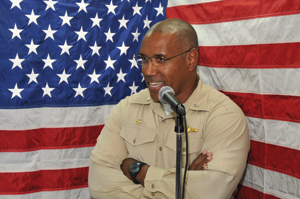
Stanley Keeve ’88 is in charge of a billion-dollar piece of equipment. As commanding officer of the USS Roosevelt, a 509-foot-long Navy destroyer patrolling the Indian Ocean, he’s responsible for making sure the helicopters, missiles, guns, radar, and other weapons systems are functioning properly and the 300 sailors are ready at a moment’s notice to engage in action. In his nearly 20 years as a naval officer, he’s hosted heads of state, briefed the Secretary of Defense, and traveled the world.
Yet what’s most satisfying, he says, is watching his crewmembers—some as young as 18—grow as individuals and sailors. “Even though it’s always rewarding to get the mission done and keep everyone safe,” says Stan, “the thing that really gets me going is being able to make change in young people’s lives.”
One of the most challenging aspects of his job as commander of the USS Roosevelt, which he took over in May 2008, is tending to his crew’s physical and emotional needs, he says. When he spoke in late February from port in Jordan, Stan had just completed 82 straight days at sea and was nearing the end of a seven-month deployment.
“When you go that long at sea, the sailors’ mood is up and down,” says Stan. So he makes sure they stay in touch with their families, eat well, and get exercise.
Just as important, he says, is “getting to know them as people”—their backgrounds, families, and goals. Stan runs a book-discussion group with the sailors and encourages them to seek his guidance if they have problems. For example, he helped one sailor redirect her career path from the engine room to legalman (a paralegal who assists Navy lawyers), which was more conducive to her interests and skills, he says.
Being captain of a Navy ship, says Stan, is like being a “mayor, judge, teacher, parent, and counselor rolled into one.” Any given day he might monitor the ship’s maneuvers around merchant vessels, track the weather, supervise training events, chair a planning meeting, and check on the engineering plant. “Essentially, you are on call 24/7,” he says.
The USS Roosevelt’s mission is to provide a presence in one of the world’s hot spots to US allies in the region, and to be a deterrence to other countries. Being captain requires a steady hand—to maneuver safely through sometimes-stormy waters and tight spots. Twice during this deployment, Stan has led the ship for some 12 hours through the relatively narrow, long Suez Canal, without incident. A regular “semi-hazardous” operation occurs every 10 to 14 days, when the ship needs to receive fuel from a bigger ship. The vessels connect lines and hoses and travel side-by-side for about two hours. “Whenever you bring two large ships together there is a potential for collision,” says Stan.
Stan’s background prepared him for the disciplined life of a Naval officer. From a blue-collar family outside Washington, DC, he attended community college before transferring as a junior to TCNJ, working about five different jobs to pay his way while majoring in electrical engineering. He first got the idea for military service as a youth watching F-4 Phantom planes overhead returning to Andrews Air Force Base. Two years after graduating college, he entered Officer Candidate School in Newport, RI.
The Navy has opened up the world to Stan and his wife, Glenora, a 1986 graduate of TCNJ. They’ve lived in California, Florida, Italy, and Japan, and today are based in Washington, DC, where Glenora works for the technology consulting company BearingPoint and takes care of their daughter. Before Stan’s assignment on the USS Roosevelt, he was stationed at the Pentagon, where he helped plan operations around the globe and briefed decision-makers at the Department of Defense. The only time he has been involved in combat was in 1999 aboard the USS Philippine Sea, whose crew fired some 30 missiles into the former Republic of Yugoslavia.
Although one might imagine leading a crew of hundreds would require a charismatic individual with a larger than life ego who barks orders, Stan says his experience paints a much different scenario. Being an effective leader, he says, involves gaining the crew’s trust. To do that, he says, an officer needs “humility, patience with people, and empathy with others.” That takes time.
But “once you establish that trust,” he says, “You are golden as a leader, because people will follow you anywhere.”
Posted on May 29, 2009