
Making science beautiful
How Melanie Hutnick ’12 brings a love of chemistry to the makeup aisle.
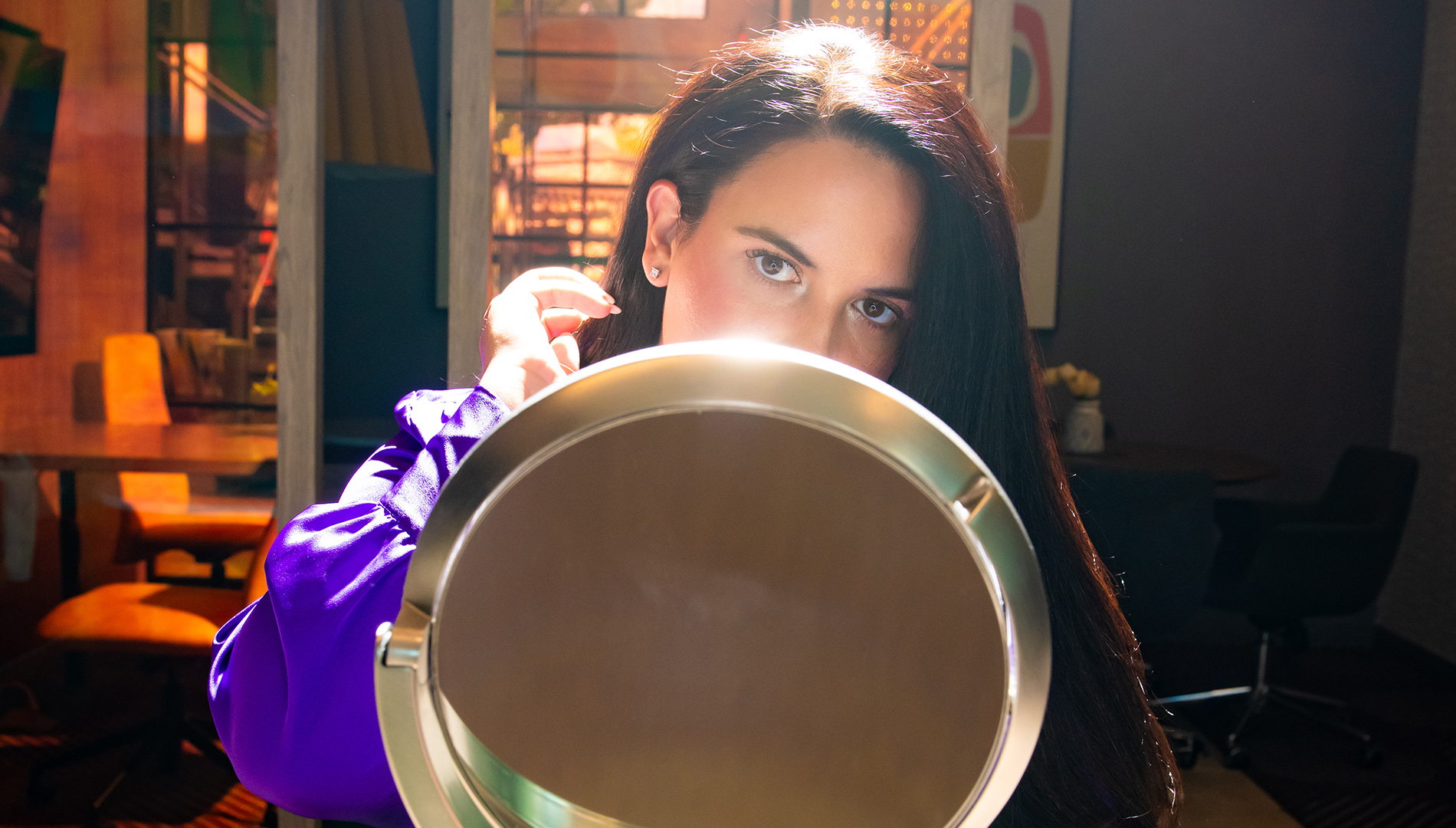
Melanie Hutnick '12, chemist for Maybelline at L’Oréal
MELANIE HUTNICK ’12 was in a high school chemistry class when she had what she calls an “aha” moment: “I think like a chemist,” she realized.
The question then became how to turn that realization into a career she would love. She found her answer one day while doing her makeup and reading the ingredient list on the package: I could be a cosmetic chemist. “From then on, I had a one-track mind,” she says.
By the time she arrived at TCNJ, she already knew where she hoped chemistry would take her. “I was branded the ‘cosmetic girl,’” she says. For the chemistry department’s annual mock interviews, Hutnick arrived each year with a L’Oréal job posting in hand.
That certainty carried her through a chemistry degree at TCNJ and a PhD at Case Western Reserve University, and it set the course for the rest of her career, as well.
Today, Hutnick is director of research and innovation at L’Oréal, where she leads the team of chemists behind face makeup for the brands Maybelline and NYX, from foundations and concealers to setting sprays. Those formulas eventually make their way onto shelves and into millions of makeup bags around the world.
Bringing a product from the lab to market requires Hutnick to translate complex science for marketers and executives. She mastered this skill early in her career when she worked for Estée Lauder. A mentor there gave her a piece of advice that stuck: “If you can’t sell your science to the marketer, the marketer doesn’t know how to sell your science to the customer.” His test for whether an idea was ready to pitch was simple: Could you explain it to a fifth grader?
To pass that test, Hutnick became a regular at Michaels, where she would pick up supplies to build dioramas and demos that made chemistry click at a glance. Before long, she was using those homemade props to present new technology to senior leaders, including brand presidents and company CEOs.
One such example, she remembers, used a glass rod in oil and water to demonstrate refractive index, a measure of how light bends as it passes through a material. In oil, which has a similar refractive index to glass, the rod can seem to disappear. In water, which bends light differently, that same rod appears broken. This principle applies to how different formulations of cosmetics work: Materials with a refractive index similar to skin can blend into the surface for a natural- looking finish, while others can help blur imperfections.
She remembers being told: “You’re so good at explaining such technical, highbrow things in such relatable, tangible ways that people understand.”
Hutnick traces that skill back to TCNJ, where her senior-year chemistry courses required what professors called “Don’t Be Such a Scientist” reports: lab write-ups aimed at making technical concepts understandable to the average reader. Hutnick tested her assignments on non-science majors, asking, “Do you understand what I’m trying to say?” Their answers revealed whether a report was ready for her to submit.
WHEN ASKED WHAT MIGHT SURPRISE people about her industry, Hutnick doesn’t hesitate. “You could major in literally any scientific field and find a role,” she says, listing them off: microbiologists focusing on product preservation, toxicologists confirming safety, physicists testing stability, and engineers scaling up production. “Truly, every single science is represented within the cosmetics industry,” she says.
Hutnick credits a chance encounter years ago for her ability to understand that any given industry depends on people with skills in various fields. Growing up in a blue-collar family in Woodbridge, New Jersey, she had few immediate examples of unconventional career paths. But on a flight home from Walt Disney World when she was 12, she sat beside a man designing the park’s fireworks show on his laptop. “That was the first time I had ever been exposed to a cool job,” says Hutnick, who later became the first in her family to attend college.
The encounter stayed with her. Today, Hutnick encourages students to find what she calls the “hybridization between their passions.” For her, chemistry and cosmetics turned out to be exactly the right formula.
Photo: Peter Murphy
Posted on October 29, 2026