Research that ripples
How mentored research at TCNJ can shape a student — and generations to come.
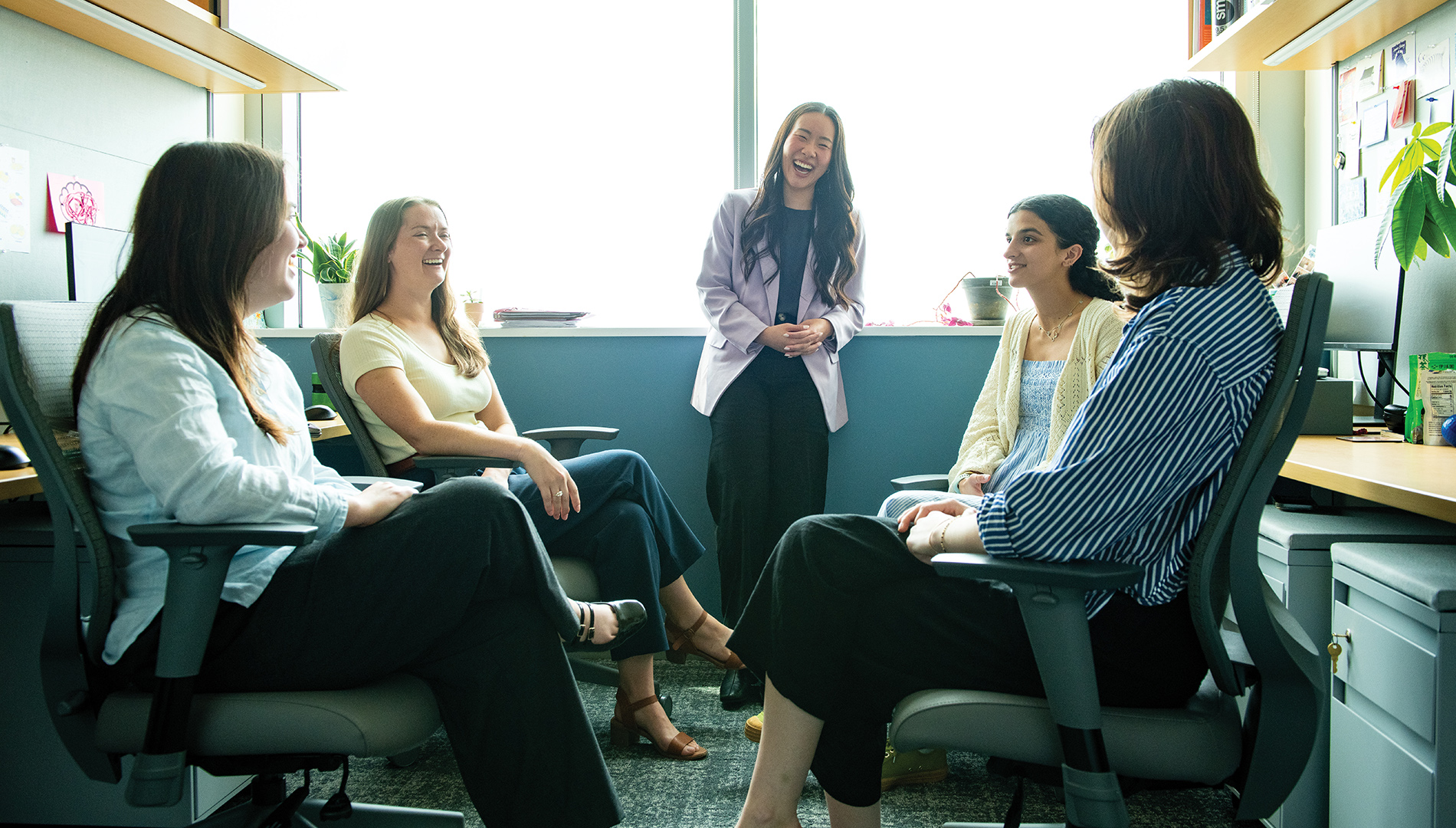
Shirley Wang '17 (standing) with her lab students at Yale
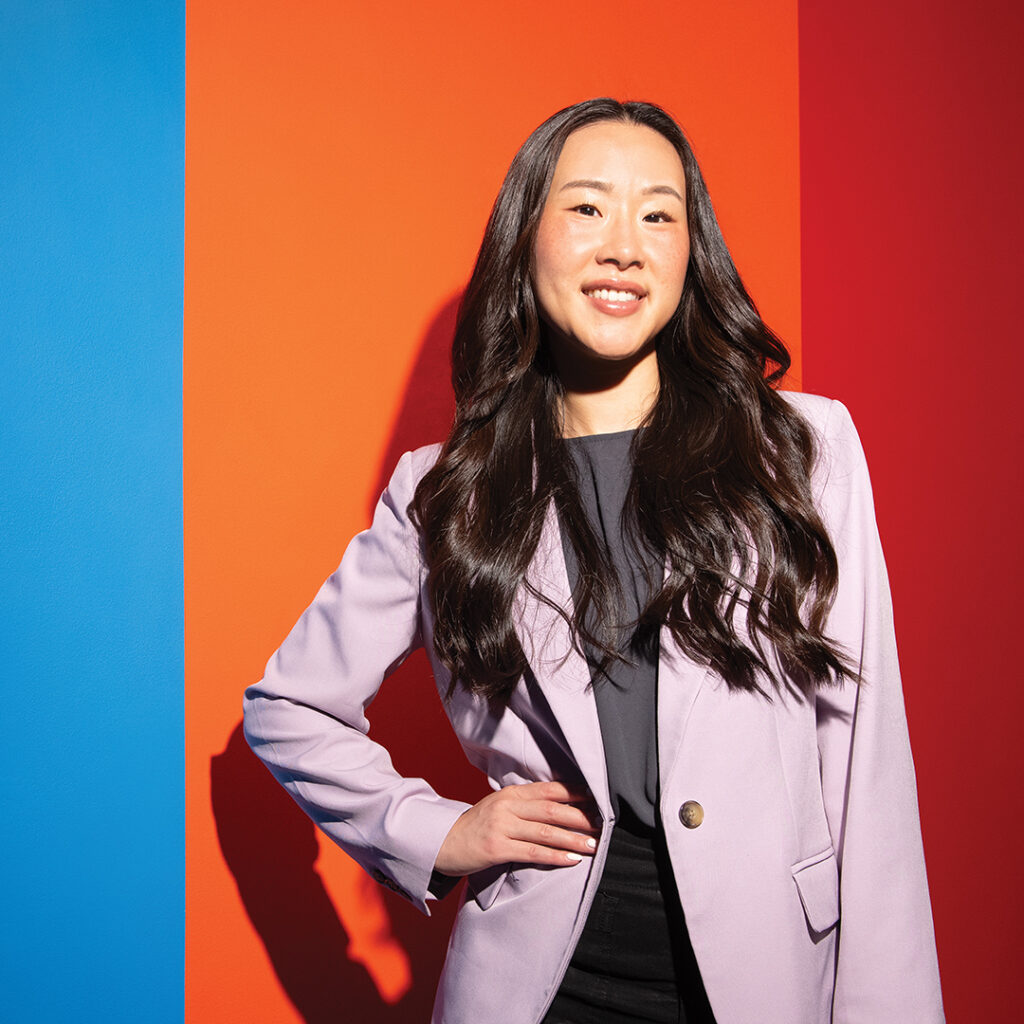
TODAY, SHIRLEY WANG ’17 runs her own psychology research lab as an assistant professor at Yale University, where she builds computational models to understand how mental health problems develop and change over time. She also mentors the next generation of scientists.
Before that came a PhD from Harvard and a recognition on Forbes’ 2024 list of 30 Under 30 in Healthcare. The roots of Wang’s career stretch back to an undergraduate classroom at TCNJ.
When she arrived at the college in 2013, Wang was a first-year student with wide-ranging interests in math, statistics, psychology, and medicine — and no idea that research would eventually become central to both her career and her identity as a scientist. Her introduction to that world came during psychology professor John Ruscio’s stats course.
Wang loved the class. She came early, stayed late, and lingered to explore the ideas discussed. Her professor noticed.
“He reached out to me and said, ‘It seems like you’re really interested in these topics. Would you want to do research with me?’” says Wang. “I had never done research before. I didn’t really know what it involved.”
That invitation would become the first of many. Wang continued working with Ruscio throughout her four years at TCNJ and developed relationships with other faculty mentors who opened doors to clinical psychology and neuroscience, including Joanna Herres and Ashley Borders. She learned to code, run simulations, and analyze data. She designed studies, presented at conferences, published her work in peer-reviewed journals, and brought these skills together through her undergraduate thesis on cognitive and affective mechanisms of eating disorders.
But looking back, Wang realizes the most consequential thing her profes- sors gave her may not have been a research skill at all. It was confidence. She remembers sharing ambitions that, to her, felt audacious: applying to PhD programs, pursuing a National Science Foundation Graduate Research Fellowship. The response from her professors wasn’t just encouragement — they fully believed these goals were well within her reach.
“They had such unwavering confidence in me,” Wang says.
Years later, as Wang navigated the vast and unfamiliar research ecosystem at Harvard, her TCNJ mentors’ belief in her became an anchor, even when she doubted herself. “I really think it was borrowed from them,” she says of the confidence TCNJ professors instilled in her.
WANG’S EXPERIENCE WAS NOT UNIQUE. It’s part of a culture that stretches across TCNJ’s campus: A professor recognizes a student’s potential, invites them into meaningful research, and trusts them to investigate questions whose answers are not yet known.
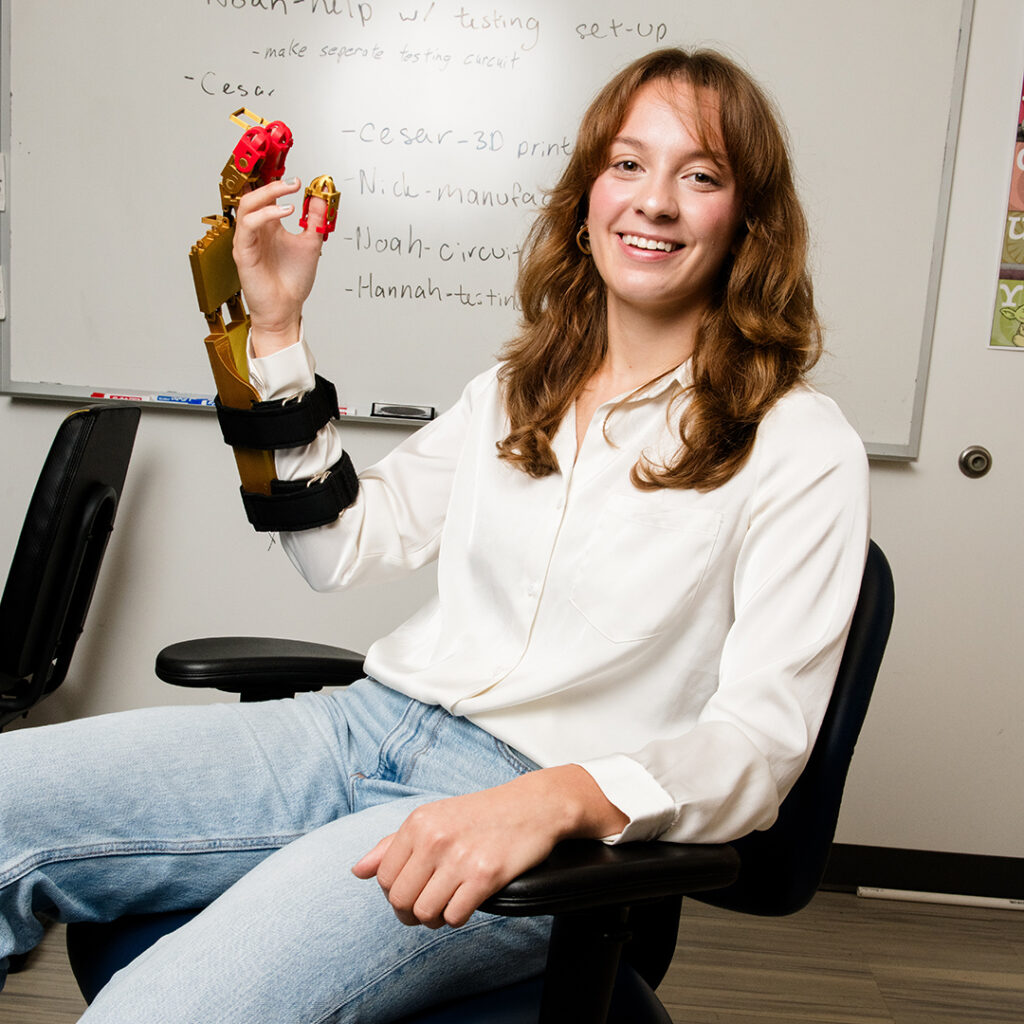
Take biomedical engineering major Hannah Hoer ’27. She’s had to get comfortable tackling problems she doesn’t yet know how to solve. Her testing ground? A powered exoskeleton for the human hand.
Working in professor Brett BuSha’s robotics lab, Hoer has spent nearly two years developing a 3D-printed wearable device that combines hard and soft robotics to assist people with hand weakness or nerve damage. Inflatable components help power everyday movements most of us rarely think twice about — grasping a cup or pinching a pen between two fingers.
The work has pushed Hoer well beyond what she already knew. After her sophomore year, she began tackling the project’s circuitry before she had even taken a formal circuit analysis course. “I’d come across a problem, and I’d be like, I know absolutely nothing about this,” she says.
So she learned. With BuSha’s encouragement, Hoer turned to textbooks, built circuits, and worked through problems as they arose. As she put in the time to solve each new challenge, her initial uncertainty gave way to confidence in her abilities.
FOR PSYCHOLOGY MAJOR SIMMER JEALF ’27, research has been as much about finding purpose as finding answers. As a Barbara Meyers Pelson ’59 Student Fellowship recipient, Jealf engaged in TCNJ’s Mentored Undergraduate Summer Experience (page 35). She examined how racial trauma intersects with mental health among Latinx college students — and whether factors such as ethnic identity, advocacy, and a welcoming campus climate can help protect students’ well-being. The work aligns closely with Jealf ’s broader interest in immigrant populations and her belief that research can ultimately help colleges better support marginalized students. “I feel like I am making an impact,” she says.
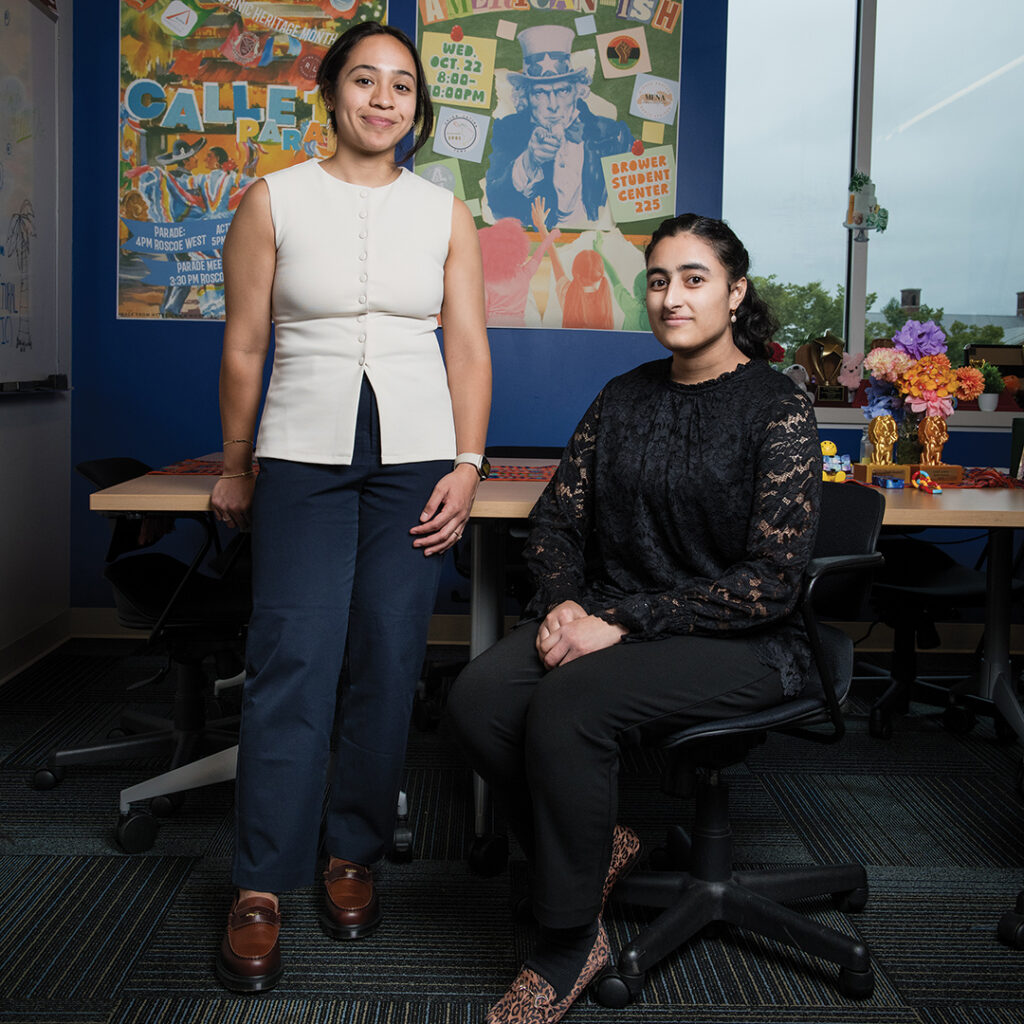
Part of the wonder of research, Jealf has learned, is that discovery unfolds gradually. She likens the process to nurturing a tree. “You keep watering it, and sometimes you wonder, ‘Is this tree even growing? It looks the same,’” she says. “But slowly, you start to see the progress.”
That growth has been personal, too. MUSE marked Jealf ’s first major leap into independent research, working under the guidance of psychology professor Raquel Sosa. She learned statistical coding — something she once struggled to imagine herself doing — and realized she had earned the opportunity she was given.
Jealf took her research beyond campus: She presented at conferences at University of Pennsylvania and in Denver. “I’ve really proven to myself that I can do this,” she says.
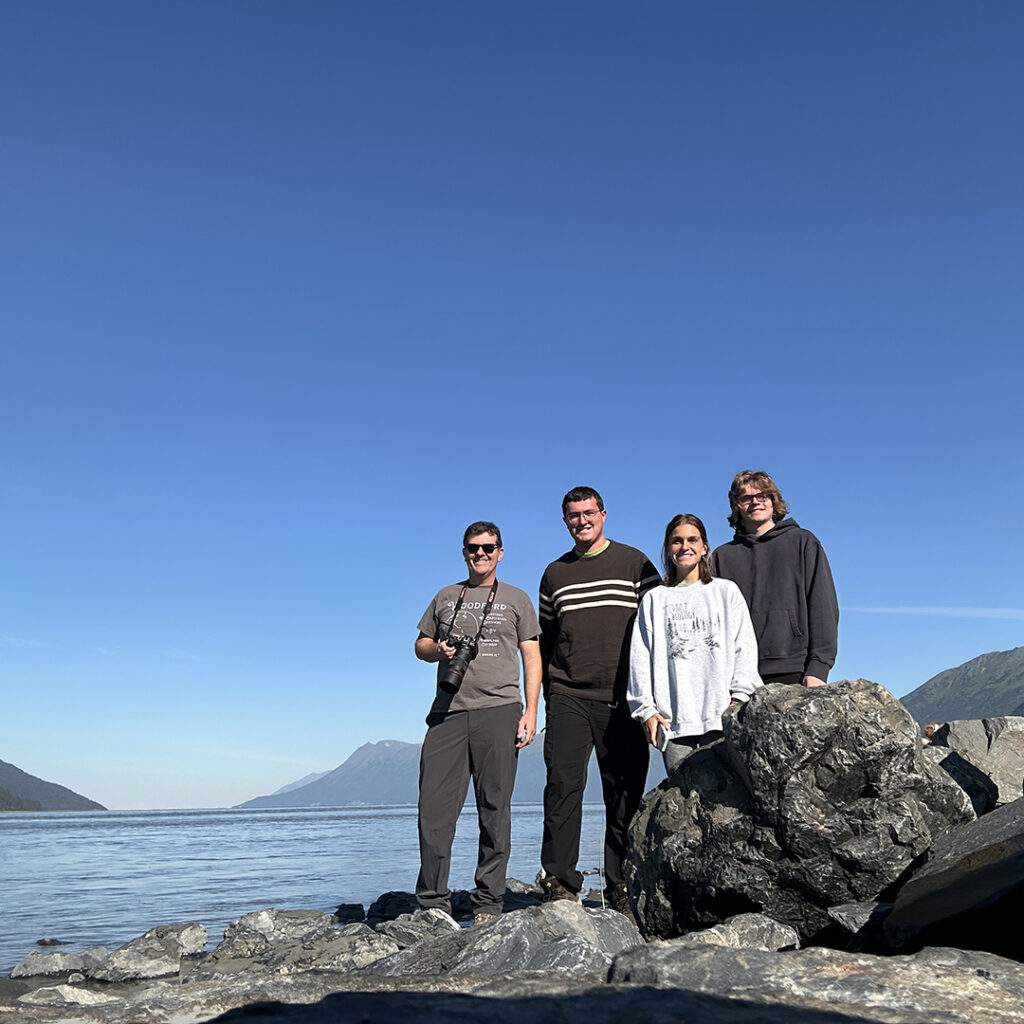
ONE OF THE BIGGEST SURPRISES OF CONDUCTING FIELD RESEARCH in Alaska had little to do with stickle- back fish, and everything to do with the people working alongside him, says biology major Miles Pedowitz ’27.
Pedowitz joined biology professor Matt Wund and fellow TCNJ students to study the early stages of species formation in stickleback populations near Anchorage. Days were spent setting and checking nets, collecting juvenile fish, and taking in a stunning landscape.
Beyond the fieldwork itself, Pedowitz was struck by how quickly the group came together. Working, cooking, and eating together, the group quickly became more than classmates and colleagues. “By day three, we were already in sync,” he says. “We knew what to do, how to do it.” The experience, he says, taught him the value of learning how to adapt and work together as a team.
For Wund, the magic of undergraduate research is most exciting at that moment when the traditional roles of professor and student start to blur. In the classroom, there is generally an answer waiting to be learned, he says, and the professor knows what comes next. But research is different.
“When you’re doing research, you’re actually applying what you know to answer questions that no one else knows,” Wund says. “The goal of science is to answer questions that no human has ever answered before.”
That shared pursuit of the unknown changes the relationship, he adds. Professors and students must adapt together when results are unexpected, drawing on creativity, different strengths, and each other. The student is no longer absorbing knowledge from an expert; professor and student become collaborators in discovery.
That, Wund says, can lead to a powerful shift in how undergraduates see themselves: “Wow, I’m a scientist. I’m helping to make discoveries.”
Wund sees another transformation when students return to the TCNJ lab after accompanying him to Alaska. The names on the fish tanks are no longer simply labels — they are lakes the students have stood beside, habitats they have explored, and fish they helped collect. That connection creates a deeper sense of ownership and pride in the work.
For Pedowitz, who hopes to pursue field biology, the experience reinforced both his love of nature and something less expected: the understanding that discovery is rarely a solo pursuit.
A DECADE AFTER GRADUATING FROM TCNJ, Wang can now see another ripple from those early research experiences: They influence not only the scientist she has become, but the mentor she wants to be. At Yale, Wang is intentional about creating the kinds of research opportunities for students that shaped her own development at TCNJ. She wants undergraduates to do more than assist with someone else’s science; she wants them to have “real intellectual ownership” of their work.
She has already watched that approach bear fruit. Wang’s first undergraduate thesis student went on to win a departmental research prize and was selected to present her work at a conference alongside a group composed largely of PhD students and postdocs — a moment Wang describes with unmistakable pride.
It was also a moment that felt familiar. She was once the undergraduate whose professors saw possibilities she had not yet learned to see in herself. Now, she is the professor opening that door for someone else. “Mentorship propagates through a network,” Wang says. “It flows.”
Photos Peter Murphy / Alaska photo Miles Pedowitz
Posted on October 29, 2026