
Homage to Hamnet
A reimagined story popularizes the life of the Bard, and English professor Jo Carney doth not protest.
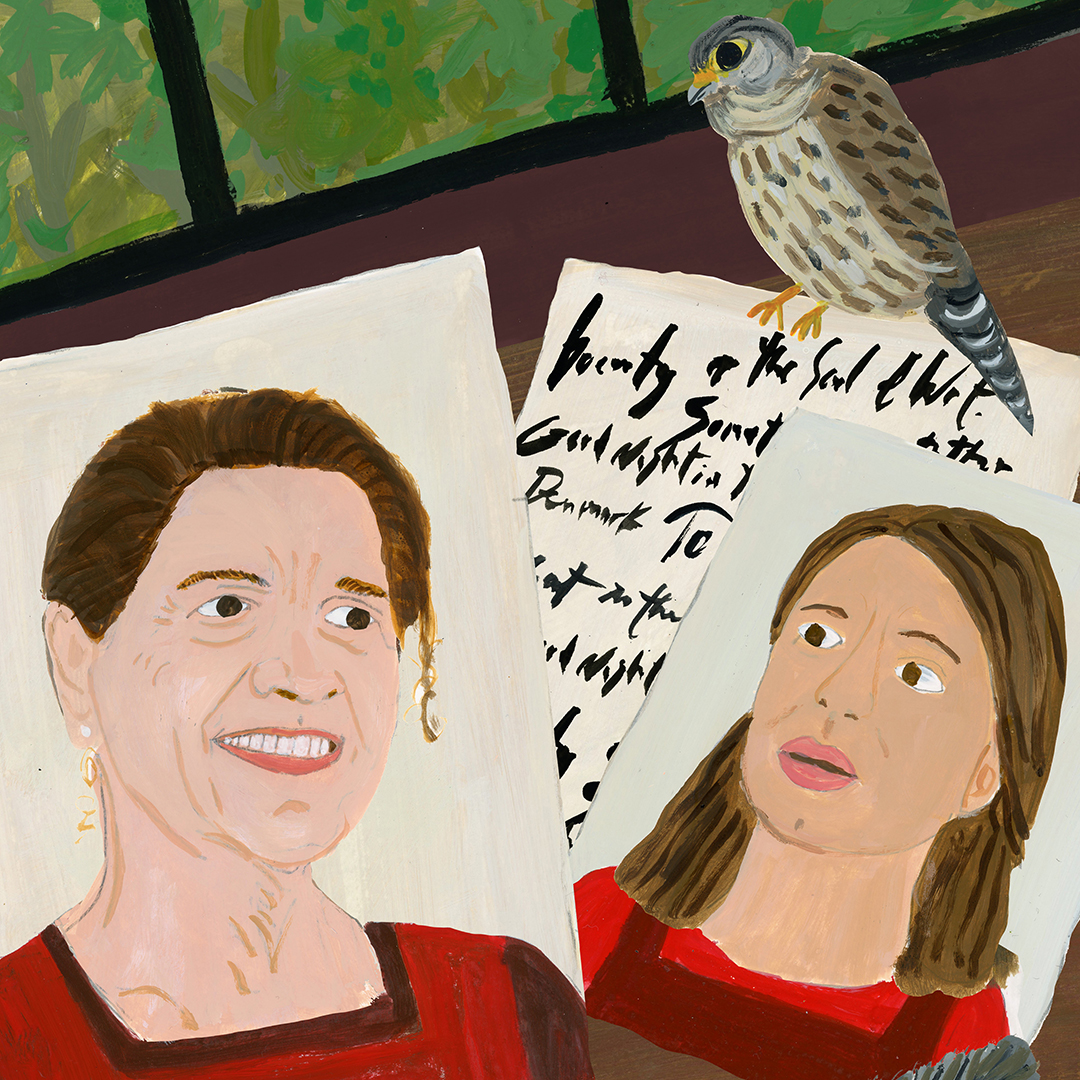
Professor Jo Carney looks at a likeness of Shakespeare’s wife from the movie Hamnet.
Hamnet, the 2020 novel and the 2025 film adaptation about William Shakespeare, his wife, and the death of their son, has captivated audiences. Has this story renewed interest in Shakespeare’s original plays?
There’s always interest in William Shakespeare —his plays, his life. But in Hamnet, there is a twist: It’s the story of Shakespeare’s son, Hamnet, who died at age 11. Book author Maggie O’Farrell wondered if there was a connection between Hamnet’s death and Hamlet, arguably the best-known play in English literature. But in researching it, O’Farrell fell in love with the story of Shakespeare’s wife Anne Hathaway — a woman history has sidelined and even vilified. O’Farrell felt that Anne deserved a corrective retelling of her life. I think especially for the younger generation, these retellings pique their interest in the centuries-old stories. Many people will see an adaptation and think, “I want to go back and read the original work.”
Is this part of a bigger trend of reimagining Shakespeare from new perspectives?
Absolutely, and it’s really exciting. In my field, we used to focus on judging adaptations based on how closely they stuck to the source. But now we understand that adaptations can enliven the canon and keep it relevant. Adaptations aren’t replacements, but rather conversations with the original works.
So how much of Hamnet is real history, and how much is imagination?
It’s a beautiful blend. The story doesn’t contradict known facts; it builds around them. The result is what I’d call “plausible fiction.” It’s invented, but deeply rooted in reality. For example, we don’t know if Shakespeare’s wife kept a falcon, but many women in her social position at that time did, so the author adds that detail. It grounds the character in her world without turning her into something unrealistic.
Your most recent book is titled Women Talk Back to Shakespeare. Is that what O’Farrell does in Hamnet?
In my book, I explore works that deliberately retell a Shakespeare play. For example, Toni Morrison’s Desdemona retells Othello from the perspective of one of the play’s female victims. I’m very interested in how contemporary adaptations talk back to, engage with, challenge, and rewrite the canonical work. But when I read Hamnet, it felt like O’Farrell was talking back toShakespeare, too. She’s responding to centuries of assumptions about Shakespeare’s wife, especially this idea that her marriage was unhappy or distant. We actually don’t know that. Hamnet reimagines her as active, intelligent, and central to her own life.
If Shakespeare could see all these modern interpretations, what would he think?
I think he’d love them. Shakespeare himself was the ultimate adapter. He borrowed plots constantly and transformed them into something new. It was very collaborative and evolving. That’s how storytelling worked in his time. So, the idea of people reworking his plays? That’s exactly what he did.
BONUS: Sixes, sevens … Shakespeare?
Shakespeare shaped the English language in ways we don’t even realize. Words like “assassination,” phrases like “what’s done is done,” and even expressions like “in a pickle” all trace back to him. Carney says that even today’s popular meme-speak phrase “6–7” actually has roots in Shakespeare, and perhaps even earlier.
“It came from a dice game,” Carney says. “If you rolled a six or a seven, you had to decide how to proceed because the outcome could go either way. Over time, that idea evolved into a phrase meaning uncertainty or confusion.”
In Shakespeare’s works, being “at sixes and sevens” meant being in a state of indecision or disorder. So, when kids these days casually throw around “6–7” (insert up-and-down hand motion here), they may very well be adapting a centuries-old phrase about being unsure or caught between options.
Illustration: Terri Kasuba
Posted on June 9, 2026