
Little Words, big business
How Adriana Carrig ’12 turned beaded bracelets into a multimillion-dollar brand built on the belief that good energy is meant to be shared.
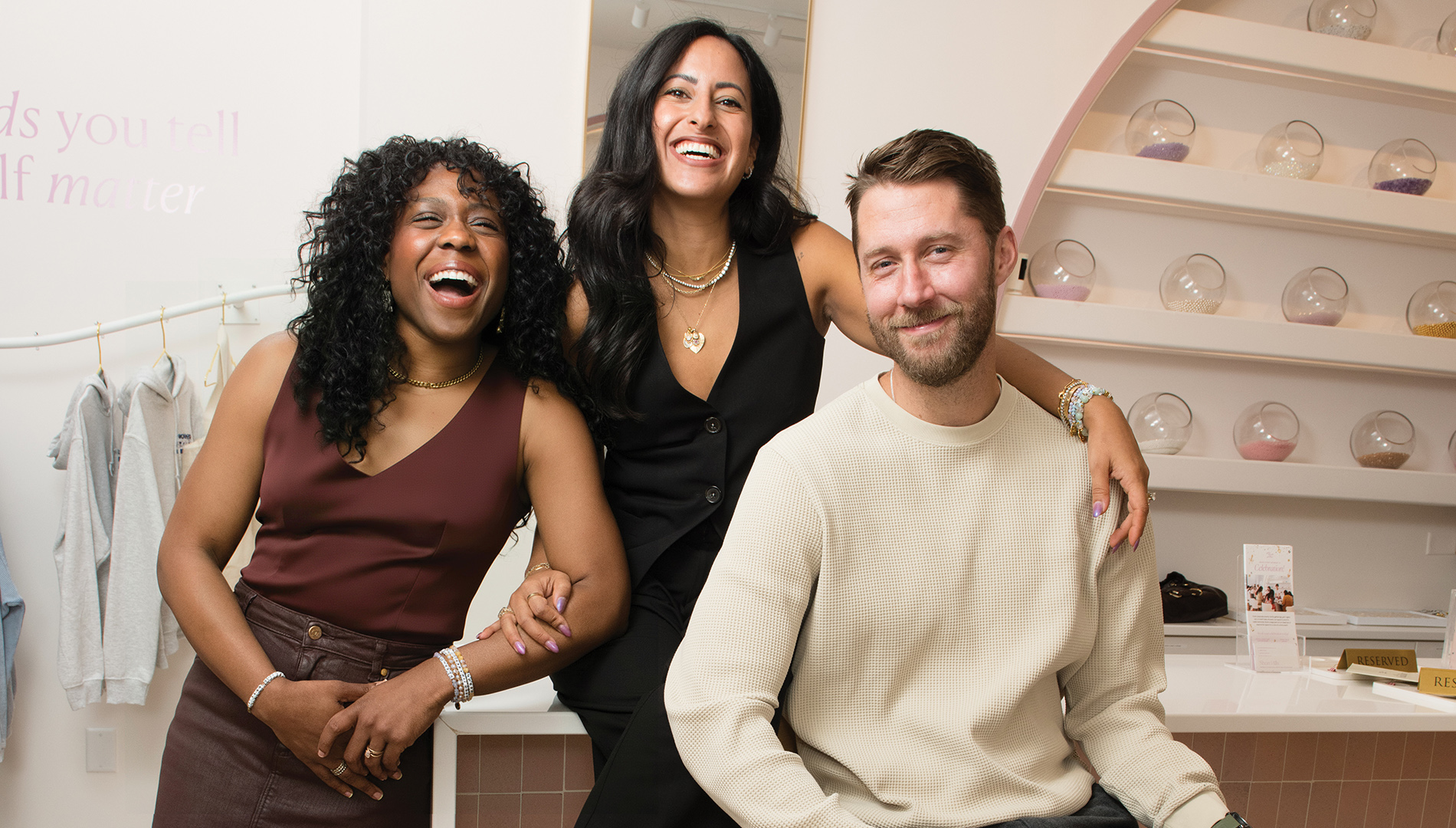
Aimee Ogbonna '12, Adriana Carrig '12 and Bill Carrig' 12
When you go to the Little Words Project store in The Mall at Short Hills, you can grab a seat at the bar, but you can’t order a beer — or anything alcoholic, for that matter. What you can order is happiness and good energy, literally. Little Words sells jewelry (beaded bracelets are a mainstay) emblazoned with short, pithy statements designed to remind the wearer, for example, to “believe,” “thrive,” and “keep going.”
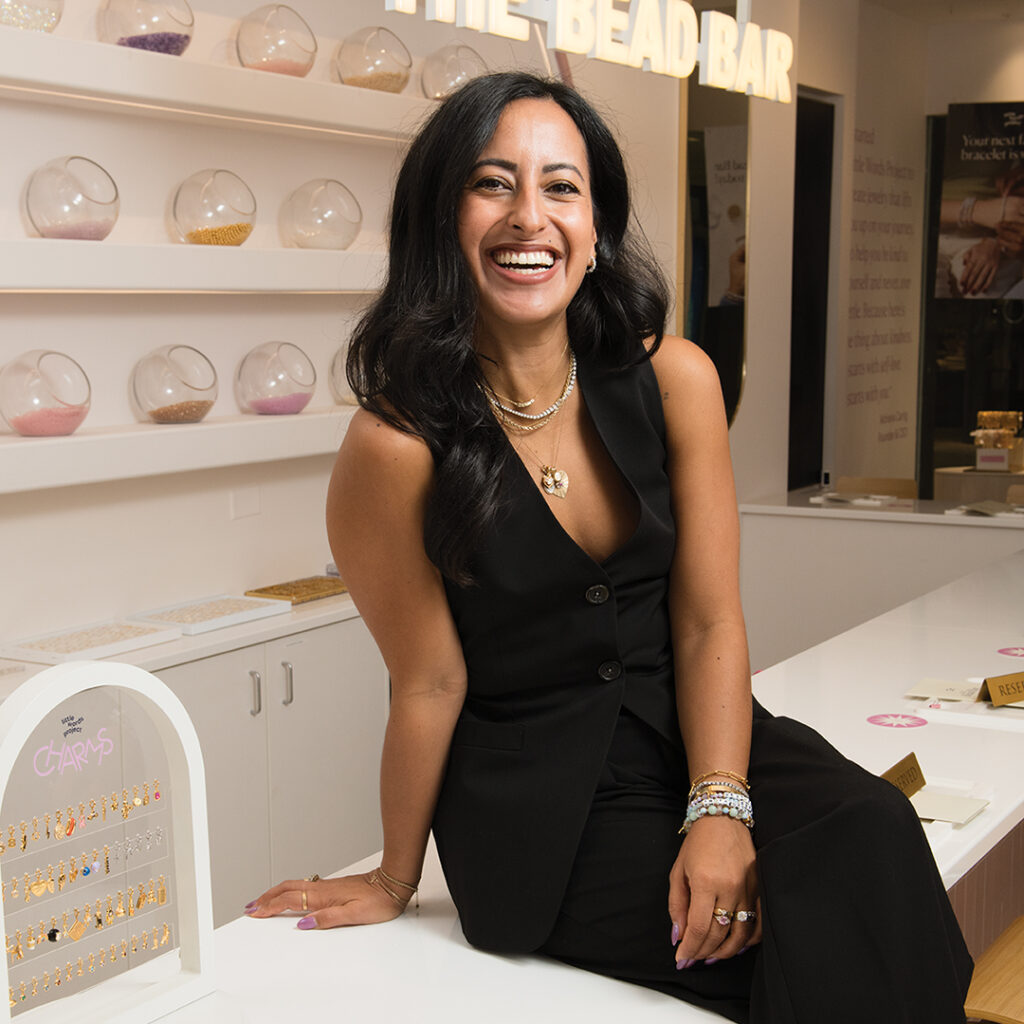
Adriana Carrig ’12, the company’s founder, is the embodiment of good energy. When she walks into the Short Hills shop, she seems to be everywhere at once: joyfully greeting the staff, briskly reorganizing the bracelet bar (where shoppers can create their own jewelry), checking out the accessories that gleam on the wall across from the bar, where they beckon shoppers with their words of kindness, comfort, and encouragement.
This shop is one of 13 across the country, from Boston and Austin to Nashville and Disney Springs. Little Words has relationships with Target, Nordstrom, Disney, Amazon, and The Paper Store. Now in its 13th year, it’s a multimillion-dollar business.
The Disney partnership, Carrig says, “is the thing I’m most proud of and excited about.” Since 2024, the company has been creating bracelets exclusively available at Disneyland and Disney World, with new designs introduced every quarter. And it’s not just parkgoers eager to acquire them. “We’re seeing our bracelets pop up on resellers for two to three times the original price,” Carrig says, “because everyone’s just trying to get their hands on this exclusive collection.”
While the brand is rooted in positivity today, its origins lie in Carrig’s personal struggle with bullying. “Honestly, there’s not a time in my life that I don’t remember going through some sort of bullying experience,” she says. Carrig traces much of the bullying — which she characterizes as “competitive cruelty” — to her outspoken and unbridled personality. “I was very much myself,” she says, “and it kind of rubbed some folks the wrong way.”
To buoy her spirits, she started creating beaded bracelets for herself bearing words of comfort and inspiration. And, in fact, it was the experience of being bullied that kindled in Carrig a desire to spread kindness, that became the basis of the Little Words brand.
Her brand was born during her early days as a sister of Delta Zeta, the sorority Carrig joined as a TCNJ freshman. As the sorority’s vice president of membership, she was tasked with the responsibility of devising a way, in her words, “to keep the love circulating.” She immediately thought of the beaded bracelets she’d made in high school, but with a twist: When she and her sisters no longer needed a bracelet — when they’d conquered a fear or achieved a goal — they’d pass it along to someone else who needed a boost.
Carrig calls that concept her “X-factor.” That idea transformed a basic piece of jewelry into something charged with meaning. She started selling the bracelets online and at street fairs and enjoyed the process of getting a business up and running — so much so that she began to reconsider her plan of heading to law school after graduation. So she made herself a deal: If her LSATs were high enough to get into Harvard Law or another top-10 option, she’d go to law school. When that didn’t happen, she says, “I took it as a sign to go full-bore with the business.”
She invested $5,000, money she’d saved while working retail at Anthropologie and Ralph Lauren. When she broke the news to her parents that she’d decided against law school and would be, as she says, “beading bracelets in their basement,” they simply asked how they could help. She wasn’t surprised. Her mother, a Mexican immigrant, moved to the U.S. at 18 entirely on her own; whenever Carrig left the house, her mother would send her off with the words “Querer es poder, or If you want it, you can achieve it,” says Carrig. “It was the first line of my college application essay, and it was just ingrained in who I am.”
In those basement-beading days, Carrig was sustained not just by her belief that she’d succeed but also by her parents’ support, both emotional and physical. Her mother would work on the bracelets with her, filling in faded letters with a Sharpie, and her father would lug boxes of bracelets to the post office. Both her parents would accompany her to street fairs and sit behind her as she sold, pitching in to customize bracelets on the spot. “This product has been about customization from the very beginning,” she says.
It’s also been about empowering women (the majority of the company’s customer base) and, yes, spreading kindness — ideas that are essentially baked into the brand. Today, the brand’s bestselling words include “strength,” “you got this,” and, of course, “good energy.” Each bracelet features a small tag carrying a number to register it on the company’s website, allowing a customer to track a bracelet’s journey from one wrist to another.
In 2015, a little more than a year after starting the business, Carrig moved her operations out of the basement, even though not everyone shared her faith that Little Words would succeed. Some local retailers called her wares “childish,” noting that they could make the bracelets themselves — responses she also occasionally received from customers at street fairs and even a few acquaintances. Luckily, she was, as she says, “delusionally confident.” Eventually, that confidence paid off. She hired a rep group — sales representatives who pitched her product to retailers — who, in 2019, clinched a partnership with Nordstrom: “one of the most pinch-me moments of all time,” Carrig says. That same year, Fortune published a feature on Little Words, highlighting the company’s rapid online growth.
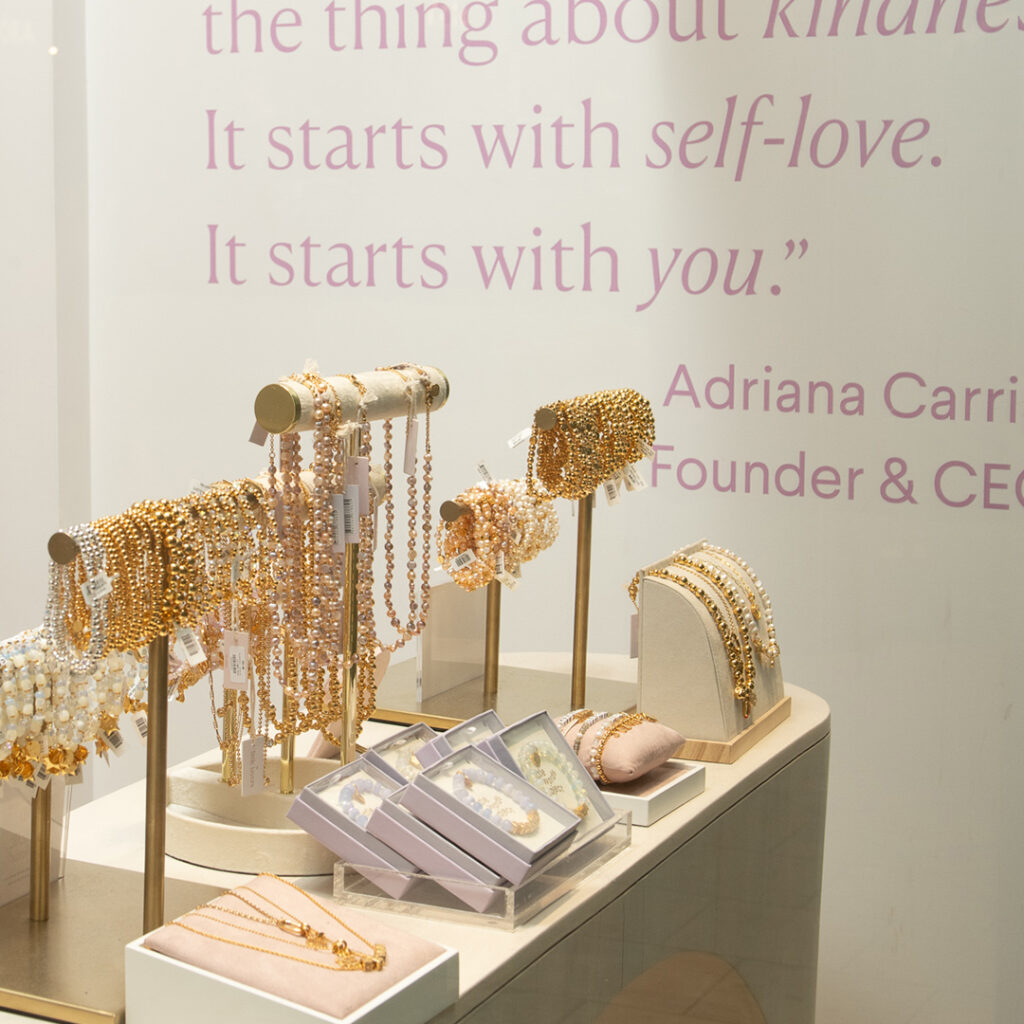
made from crystal and
stone beads, can be found in stores nationwide.
Meanwhile, the rep group wanted to pitch the line to Target’s kids’ buyers, but Carrig says she was adamant “about sticking to the demographic we knew best, which was adult jewelry.” She was right. Three years after the Nordstrom deal, Target followed suit. An unexpected jolt of momentum arrived when Taylor Swift’s fans began making and trading beaded bracelets bearing song titles and other messages. Suddenly, the media wanted to talk about bracelets and sisterhood, and Little Words became a go-to source. “We were able to get into a lot of articles that way,” she says.
Even as the company picked up steam, Carrig never entertained the notion that she could open a retail shop. That idea came from her husband, Bill Carrig ’12, whom she’d met and dated at TCNJ and eventually married in 2017. She credits TCNJ with her happiness “because I found him there.”
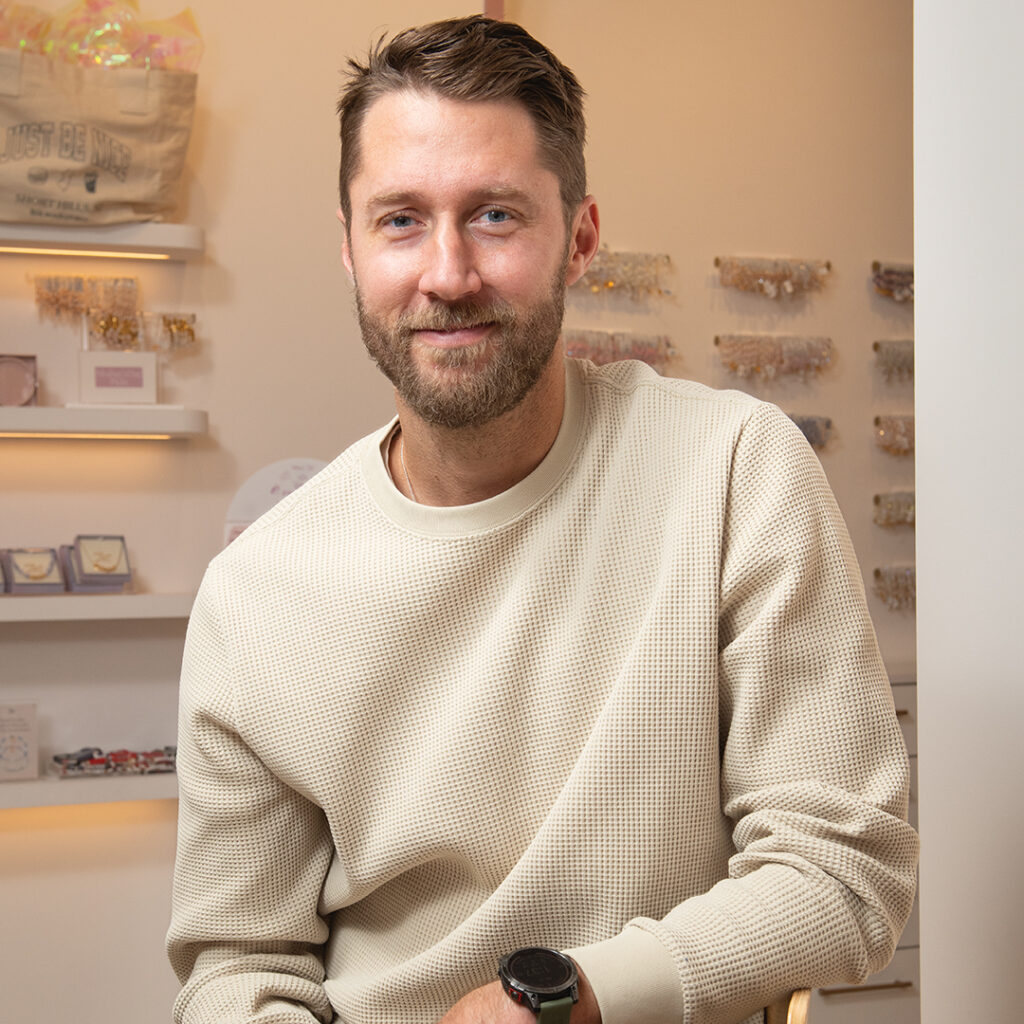
Bill had built a successful career in business, working at Johnson & Johnson and then at the multinational investment firm BlackRock. All that time, he’d been offering his wife not just support but sound — and sometimes inspired — business advice. It was Bill, for instance, who’d come up with the company name. Then, in 2021, he left Blackstone to join Little Words as chief operating officer. “It was a family decision,” he says. “I’d been at my job going on eight years, and it was great. But Little Words was getting big enough that Adriana really needed support running it.”
His suggestion that they open a retail shop that would include a communal experience where customers could sit down and make their own bracelet “made perfect sense,” he says. Though Carrig wasn’t convinced at first (her initial response: “That’s not possible.”), the idea aligned with what she’d envisioned for the company from its inception. “The bar really helped dial in on the community we’d been trying to build from the very beginning.”
In 2021, the first Little Words Project store opened on Bleecker Street in New York City’s Greenwich Village. Like all of the shops that would follow, it sold premade bracelets carrying a variety of inspirational words and phrases. It also offered shoppers the opportunity to book seats at the Bead Bar, a literal bar stocked with beads rather than alcohol, where they could create their own bracelets with custom messages and designs.
The company’s expansion to brick-and-mortar shops not only delighted consumers but also caught the attention of Disney, whose representatives reached out in 2024 to propose their now-successful partnership.
Working with Bill, who became CEO in 2025, has been a boon to Carrig — and not just because of his finance degree and years of business experience. Certainly, it supports a healthier work-life balance, especially since the birth of their two sons, Ford, born in 2021, and Jett, in 2023. “When one of us has to step in more at work, the other gets to step up more at home,” she says. And Bill, she says, “is just willing to do what it takes to support our family and my dream.”
She also hired Aimee Ogbonna ’12, her sorority sister, roommate, and now best friend. After college, Ogbonna worked in luxury hotel marketing before founding her own marketing business. Carrig hired her as a consultant in June 2023 and was impressed enough to offer Ogbonna a full-time role at Little Words only a few months later. As vice president of community impact, Ogbonna creates partnerships with nonprofits like Sad Girls Club, which provides mental health resources to women of color, the Stork Foundation, which offers financial support to people who can’t afford the staggering costs of IVF, and F*ck Cancer, which promotes early cancer detection. Generally, those partnerships involve creating custom bracelets, with $5 from each sale going to the nonprofit.
From its days in the dormitory, before it was a brand or had a name, Little Words has always been about making a difference, so the partnerships Ogbonna builds are as essential to the company as the jewelry it sells. “I call her my consiglieri,” Carrig says of Ogbonna. “She’s the person I can go to morning, noon, or night.”
The fact that Carrig hired both her husband and her best friend makes perfect sense, given the company’s ethos. “I think what makes working here really special is that most of us are friends,” says Ogbonna.
Carrig has learned to be what she calls “more precious about my time,” doing her best to think about work when she’s at work and to think about her family when she’s with them. She’s still, of course, the same person her husband describes as “someone who has insane optimism in her fingertips and can probably work harder than anyone.” She just does it a little smarter now. To underscore that point, Carrig sticks out her wrist, where a stack of beaded bracelets acts as a collective cheering section, and stretches out one in particular so that its message is clear: “in the moment.”
Photos: Peter Murphy
Posted on June 9, 2026