A beautiful mess
A professor saves an archive from going in a landfill. Her student researcher saves a part of South Africa’s storied past.
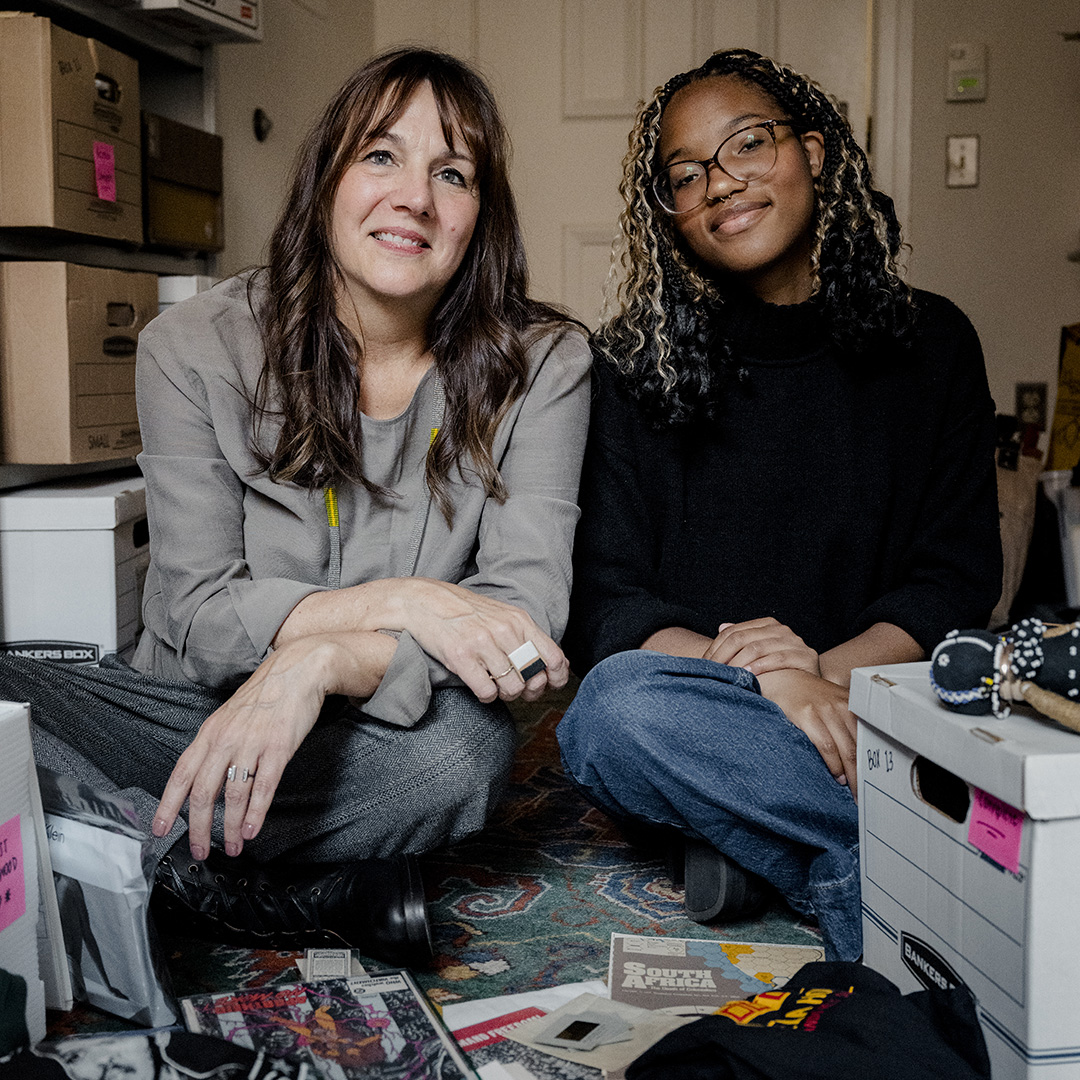
Professor Marla Jaksch and her student Ebony Riley '26
WHEN PROFESSOR MARLA JAKSCH was asked to make sense of the archives and artifacts left behind from a former colleague, she knew it would be an emotional journey. Not only would she be preserving a friend’s legacy, but she would also be revealing stories, particularly those that were often untold, of Apartheid-era South Africa. As Jaksch stared at a roomful of boxes in Bliss Hall that needed unpacking, she knew she would need the right student to help her document the contents and make something of them. She issued an invitation to Ebony Riley ’26, an “astute, thoughtful student” who had excelled in Jaksch’s research methods course. Riley accepted, and then the duo set out to piece it all together.
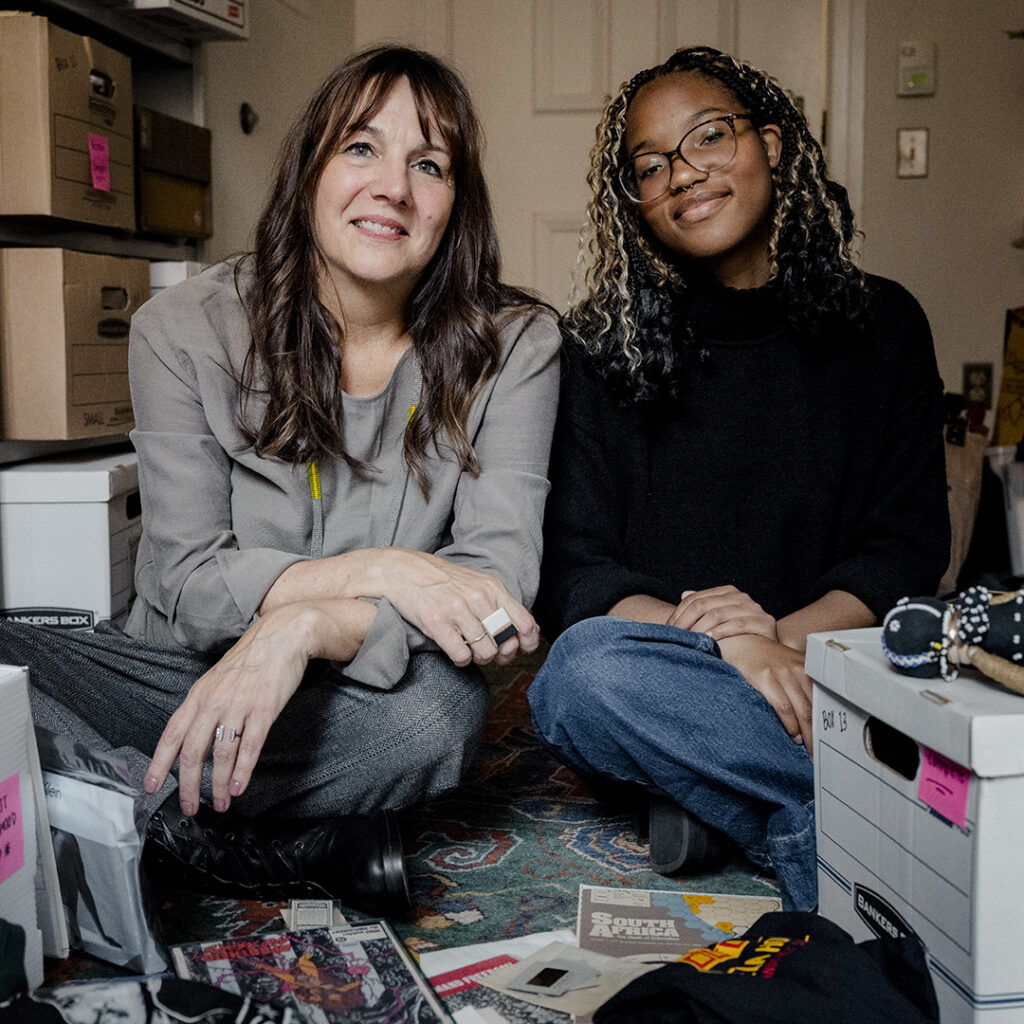
“It’s a bit messy,” Jaksch says, “but this is the story.”
JAKSCH MET ÁNGEL DAVID NIEVES (the collector of the archives now in Jaksch’s possession) two decades ago. She was conducting research on women’s and girls’ contributions to the struggle for liberation in the East African nation of Tanzania, and Nieves was a professor of Africana studies at Hamilton College in New York. The two became academic collaborators and fast friends.
Throughout his research, Nieves had collected items that challenged the conventional narrative of equity and social justice in South Africa, and he had sought to make the materials accessible in a tangible and meaningful way. “He was really pushing at the vanguard of the digital humanities,” Jaksch says, referring to Nieves’ dedication to digitally preserving materials and analyzing their historical importance.
When Nieves died in December 2023, he left behind a large collection of artifacts from his travels, including many objects that represented the Soweto uprisings of 1976, where South African police opened fire on Black student protesters. He had intended to create a multi-modal archive that would tell the history of South Africa’s townships — the segregated communities into which Black residents were forced during Apartheid, the system of institutionalized racial segregation that existed until the early 1990s.
The collection’s contents — more than 20 years’ worth of materials — were strewn across storage units in multiple states and were bound for the landfill. Nieves’ sister stepped in and asked Jaksch to make sense of what may be valuable to the historical record. So Jaksch took a van to gather the boxes, which sat in her garage and then in Bliss Hall, until she could figure out what to do with them.
ALTHOUGH RILEY WAS EAGER to contribute to the arduous project of recording each item that existed in the various boxes, her studies had mainly focused on analyzing text on a page, not digitizing and archiving a disparate collection of historical materials. Thankfully, Jaksch gathered a team to train Riley (see sidebar, left). Cassie Tanks, a scholar who was working with Nieves when he passed, taught Riley how to use a light box to capture images of artifacts so that they could be digitized. Tanks explained the inherent subjectivity in the language archivists use to describe and categorize objects. This can be particularly true when the materials are connected to complicated and contested histories.
“Archivists have a lot of power over how the story of an artifact gets to be told,” says Riley, who learned how to record data about each item that would best preserve the full truth of the collection.
Debra Schiff, TCNJ’s archivist, also pitched in. She arranged a series of five workshops to teach Riley how archives are organized, how to care for and catalog artifacts for long-term preservation, and how researchers might someday use the archive she was helping to develop.
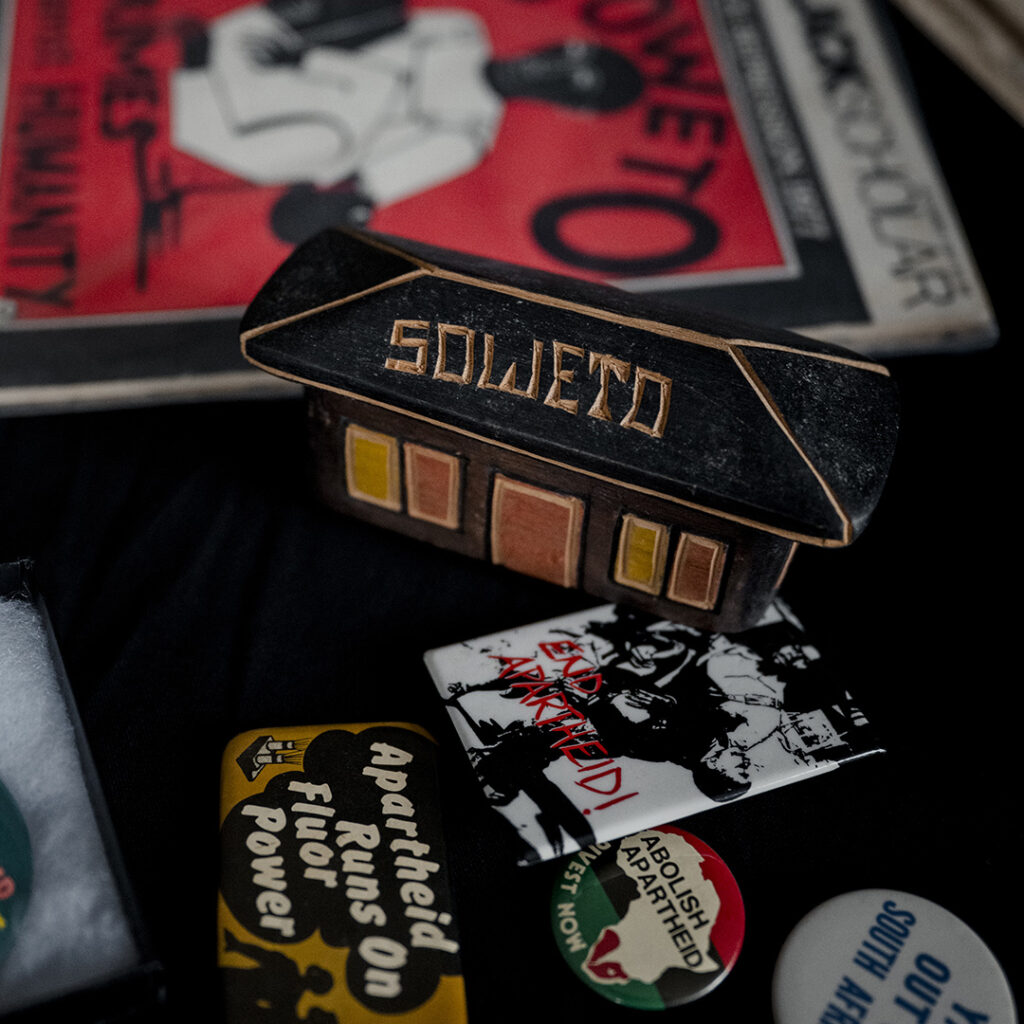
With Jaksch, Riley listened to music, watched films, and read about the history that gave context to the items that they were discovering in the boxes — a woven Zulu hat; the cap and badge of a South African police officer; anti-Apartheid issues of DC Comics; and countless postcards, maps, photographs, books, and slides that shed light on a time in history.
Jaksch was right to suggest that it would be an emotional journey. Much of the collection reflected the tragedies of Apartheid and its aftermath: decades-old cassette tapes featuring interviews with women who were imprisoned and tortured during Apartheid and reproductions of an iconic photo from the Soweto uprising, in which 18-year-old Mbuyisa Makhubo carried 12-yearold Hector Pieterson, shot by police, in his arms.
A lot of the materials really speak to resilience and resistance, not just trauma,” Jaksch says. “Although the trauma exists, too.”
EVEN IN SEEMINGLY INNOCUOUS OBJECTS, Riley found layers of meaning. A princess doll made her question its implications for South African girlhood. A small wooden model of a Soweto house revealed to Riley the significance of careful and considerate archival work. At face value, the figurine was once available for purchase at the Apartheid Museum in Johannesburg, suggesting it may have been treated as a decorative souvenir or keepsake. But houses like this one were used to relocate Black families displaced by the Apartheid government, making it both a home and an embodiment of their pain, as Riley described in the details she wrote to help future researchers properly understand the object.
“This is not just a souvenir,” she says. “This is much more than that.”
The Soweto house and other pieces of the collection led her to ask the questions that Jaksch and Schiff say are part of thoughtful archival work: “What is the story it’s telling based on the metadata that you’re writing?” Riley says. “What are the things that you’re leaving out and the perspective that you’re writing from?”
Riley’s work with the collection has carried her to unexpected opportunities, including presenting on her experience at an October conference hosted by the Curriculum and Pedagogy Group in Mexico City. There, she detailed the process of accessioning materials — recording their addition to the archive — and encouraged attendees to consider the items they would archive to represent places where they have felt belonging or un-belonging. She also gave a guest lecture for an online course at UCLA, offering students a window into what it looks like for a newcomer to dive into archival work.
Riley has been asking herself how best to honor the Apartheid stories that need to be told and how Nieves’ collection can serve that aim. “This is a lot bigger than myself,” she says.
Riley and Jaksch prepared an exhibition of the archive with displays in both TCNJ’s R. Barbara Gitenstein Library and in the side art galleries in the Art and Interactive Multimedia Building. Pieces from Nieves’ collection are presented alongside newspaper clippings revealing what student activism looked like at TCNJ during Apartheid. The exhibition, which runs through February, was timed to the 50th anniversary of the Soweto uprising.
Jaksch describes developing the collection into an archive as a “labor of love.” As much as the work is about what emerges from the archive — the education it can offer and the research it can support — it’s also a reflection of the care that goes into its creation, the people who made it, and the people whose stories it contains. There is still plenty to be done, and the path ahead is uncertain, much as it was when she first gathered the boxes. But she’s eager to keep moving forward on the journey with Riley, she says.
“This archive is now really in our hands,” Jaksch says. “So we have a responsibility to the people whose lives are in this archive, whose legacies and struggles we now hold.”
Photos: Hannah Yoon
Posted on January 29, 2026