
The art and the deal
David Rago ’16 bids his time as owner of New Jersey’s largest auction house.

David Rago '16
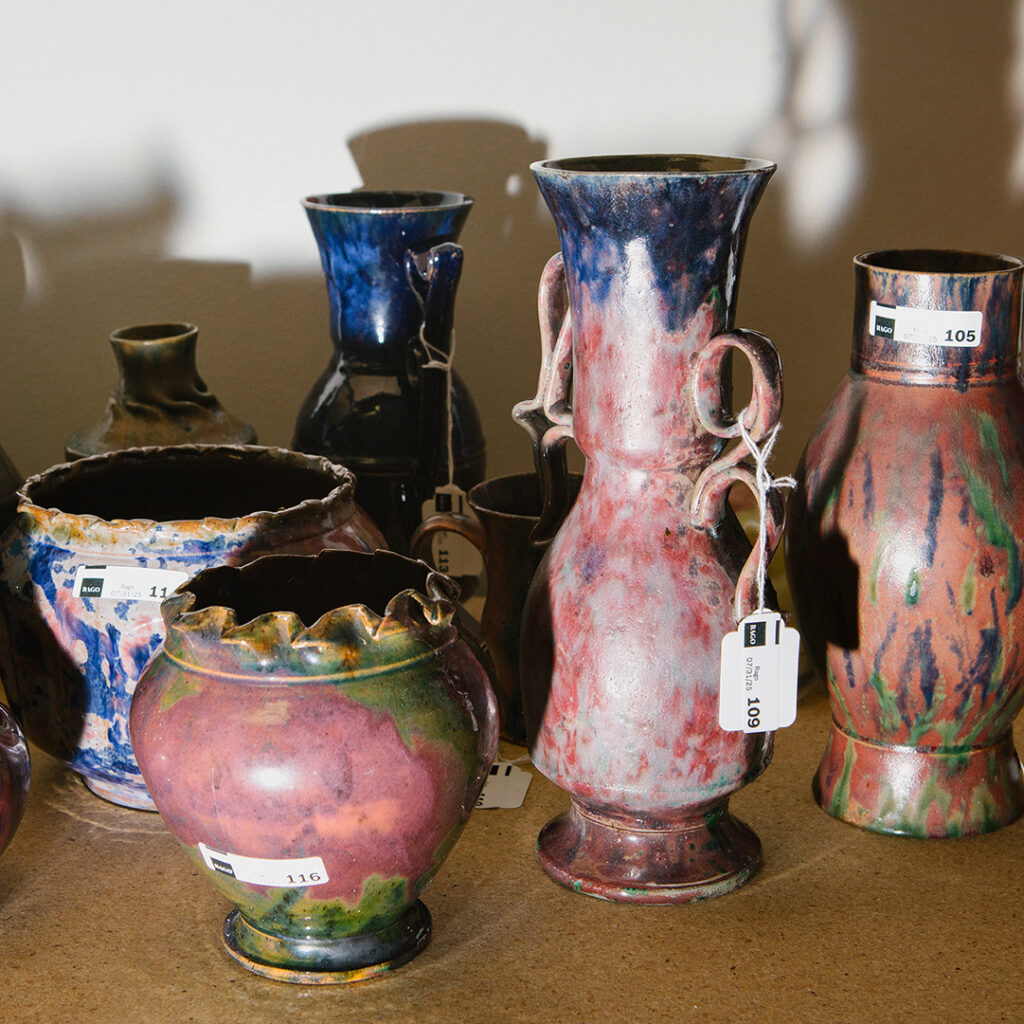
Things are quiet but busy on a Wednesday summer afternoon inside the vast warehouse of Rago Art and Auctions in Lambertville, New Jersey. Objects of significant value sit on tables and in glass cases, while a half-dozen employees assess and log each one. There’s a collection of highly coveted George Ohr ceramics — pottery obtained from a private collection that’s expected to fetch $40,000 to $50,000 apiece. Spread out on a table are some Tiffany lamps, ready to be auctioned. Just a few years ago, Rago Auctions sold a Tiffany Dandelion lamp for a world-record $3.7 million. A pop-culture expert on Rago’s staff sits at a small desk, carefully appraising a collection of comic books, knowing a trove of comics at Rago recently sold for $1.7 million.
At the head of the operation is David Rago ’16, the company’s founder and namesake. Rago is neither an artist nor a collector. Instead, his special skill is finding art, building excitement around that art, and providing the forum for buyers and sellers to settle on a fair price. “When someone has something to sell, you want them to think of you,” he says. Thus, Rago has his finger on the pulse of what buyers are looking for and where to find it as he routinely deals in a world of tangible things with intangible value.
Rago’s auction house, the largest in New Jersey, does more than $120 million in annual sales, selling more than 25,000 lots of American fine art, modern furniture, and jewelry every year. Rago himself is well known to viewers of PBS’ Antiques Roadshow, where he has appeared as an appraiser for 30 seasons.
Rago’s path to the art world was somewhat untraditional. As a teenager from Hamilton, New Jersey, he worked odd jobs to make money and especially liked buying and selling things. One of his early enterprises was to scour flea markets for pottery and ceramics to resell. His first sale was in 1972, when he accompanied his girlfriend’s father to the Golden Nugget Flea Market in Lambertville to sell goods from the trunk of a car. He made $50.
He tried a stint at The College of New Jersey, but dropped out. “My interests were elsewhere at the time,” he says. Instead, he focused on his fledgling business of selling flea market finds. He hustled other work on the night shift at a supermarket and wrote articles for small art and design magazines in exchange for free advertising for his startup.
Early on, much of his business centered on decorative ceramic bowls and vases, which were abundant and prized possessions in the areas around Trenton, where he grew up. “If you were in a middle-class family around here, you knew you’d better not be breaking the piece of porcelain your parents had on the trophy shelf,” Rago says.
Within his own family, art was something that was always present — his father was a professional draftsman and an amateur painter, and Rago recalls “the smell of oil paints wafting through our house.” For Rago himself, it was a piece of low-end pottery his parents bought from the Roseville Pottery Company in Zanesville, Ohio, in 1973 that sparked his interest in art — specifically 20th-century design. “I still can see that moment in my head,” he says of the day his parents brought it home to their collection. “It was love at first sight.”
What resonated with him? It was the realization that the beauty of the piece came from the simplicity of the material. He explains, “When you think of pottery, it’s mud.”
At the time, there was a growing enthusiasm for decorative arts among scholars and collectors who followed the American Arts and Crafts movement, which encouraged artists to create objects with everyday materials (such as mud). Rago became a self-taught expert and developed an eye for knowing which pieces could have value. He adopted a dictum from Arts and Crafts designer William Morris that he has carried into his own business philosophy and that he has displayed on his desk even today: “Have nothing in your houses that you do not know to be useful or believe to be beautiful.”
By the early 1980s, Rago was well known in art circles as a specialist in 19th- and early 20th-century arts, and he worked in various galleries in New York. He founded his auction company in 1984 and now runs it with his wife, Suzanne Perrault. It started as a small operation, with Rago loading up at his warehouse in New Jersey and heading into New York solo to participate in auctions. In 1996, Rago bought the warehouse in Lambertville and began hosting auctions there. They expanded in 2016, and Rago Auctions now employs 135 people. In all, Rago Auctions holds 175 auctions each year, some in partnership with five other independent auction houses around the country. Still, Rago is quick to point out that they are relatively small in a world of auction houses like Christie’s or Sotheby’s. “We did $121 million last year,” he says. “That’s one painting at Christie’s.”
Running an auction is an art form in and of itself. Rago and his team classify each auction into a theme based on artist, type of art, or special collection: say, for example, 20th-century ceramics or post-war design. Then the items to be sold are catalogued and carefully arranged in an order for bidding that would hopefully establish a rhythm for the overall sale.
For Rago, an auction is as much about the storytelling as it is the actual art. He considers the bidders who will be there and which works are more likely to be sold and at what price point. “The ordering — like editing together strips of film for a movie — is very intentional,” he says. “Pacing is like an oscillating line, starting with high points and then introducing less expensive work and then up again, to create the ebb and flow of the energy of an auction session.”
Rago’s skill as an auctioneer also contributes to the unfolding of the story of any given auction. “I try to be in the moment,” he says. “And I use the pace of my language to build interest —sometimes not saying anything at all, or modulating my volume, or making comments about the objects.” He adds: “Understanding the material and the intended market is an essential part of this process. I’m learning new things every time I’m up there.”
Building relationships is also essential. Rago says he spends most of his time “schmoozing.” Instead of acquiring his own art and selling it, he acts as a middleman between the consignors (those with collections to sell) and the buyers. That means Rago always has to be aware of coveted objects, who owns them, and whether they are interested in selling. He also has to be aware of trends and know what buyers want. Rago takes a percentage from both after the bidding process ends, so he needs to be trusted from both sides. “It’s a small world. Your word is your bond,” Rago says.
Being such an enthusiastic, trusted art handler is what landed Rago on Antiques Roadshow as a regular expert on pottery and porcelain. “David’s connection to the pottery world is so deep,” says Sam Farrell, supervising producer of the long-running PBS show. “It’s totally apparent when David is excited about something in his area of expertise. He’s a passionate observer and player in that world. And he talks fast, but he doesn’t miss a beat.”
He also doesn’t leave things unfinished. Rago’s continual drive to learn led him to come full circle and back to TCNJ as a 50-something college student in 2009. “I didn’t need the degree, but I wanted a sense of completion,” he says. “My first class was on pre-Islamic Iranian culture, and I was in a class with a bunch of 20-year-olds. It was fantastic, and I got to really apply myself.” For the next few years, he took a class every semester, eventually earning his English degree in 2016.
The art auction business has shifted a great deal in Rago’s 40 years in the industry. “The big change has been the internet,” he says.“People aren’t coming in person anymore.” Inside his Lambertville building, Rago points to the empty podium and to a few assembled chairs, where people once crowded into the auction space. “This room, at one point, would be standing room only,” he says. “Before COVID, when we had jewelry sales, there would be 100-plus people in the room. Now, if there’s 10 people in the room, five of them are consignors who want to see how their stuff does.”
Tastes, and what collectors want, are always changing, too. Rago’s beloved pottery has been waning in popularity over the past several years. “People don’t want to collect what their parents collected,” he says. But lack of interest is only part of the picture, according to Rago. “Much of the finer pieces have already been absorbed into museum collections,” he says. “And, relatively little was made in the first place.”
The generational shift is why he invested in a pop-culture department, acquiring Landry Pop Auctions, run by Antiques Roadshow castmate Travis Landry. “Tech bros are buying Pokémon cards,” says Rago. “And singer Post Malone privately bought a ‘Magic: The Gathering’ card for $2 million.” Rago recently held an auction for Atomic Age Japanese toys and sold an Astro Boy toy for a record price of $120,000. A Pokémon auction this summer yielded $1.8 million. “The younger generation of collectors wants experiences and collectibles like that,” he says. “If I only sold what I loved, I’d be out of business.”
But Rago insists that dealing in fine art and furniture is still relevant. “That’s the beautiful thing,” he says. “Auction houses want pop-culture departments bringing in younger people with money who are eventually going to settle down and nest. They’re going to need a dining room table at some point.”
Photos: Michelle Gustafson
Posted on September 17, 2025